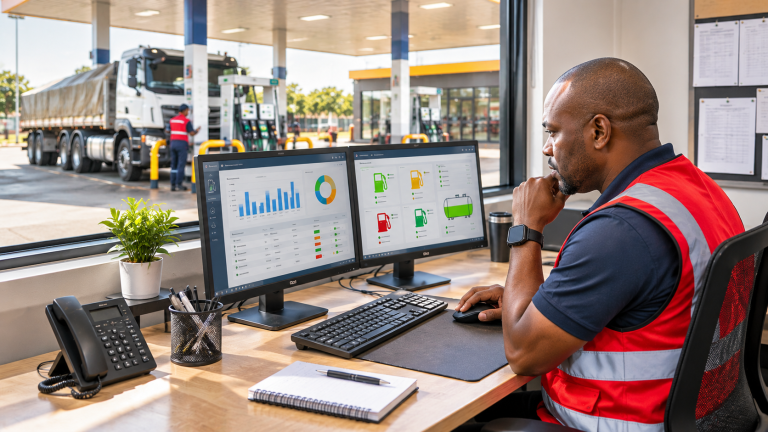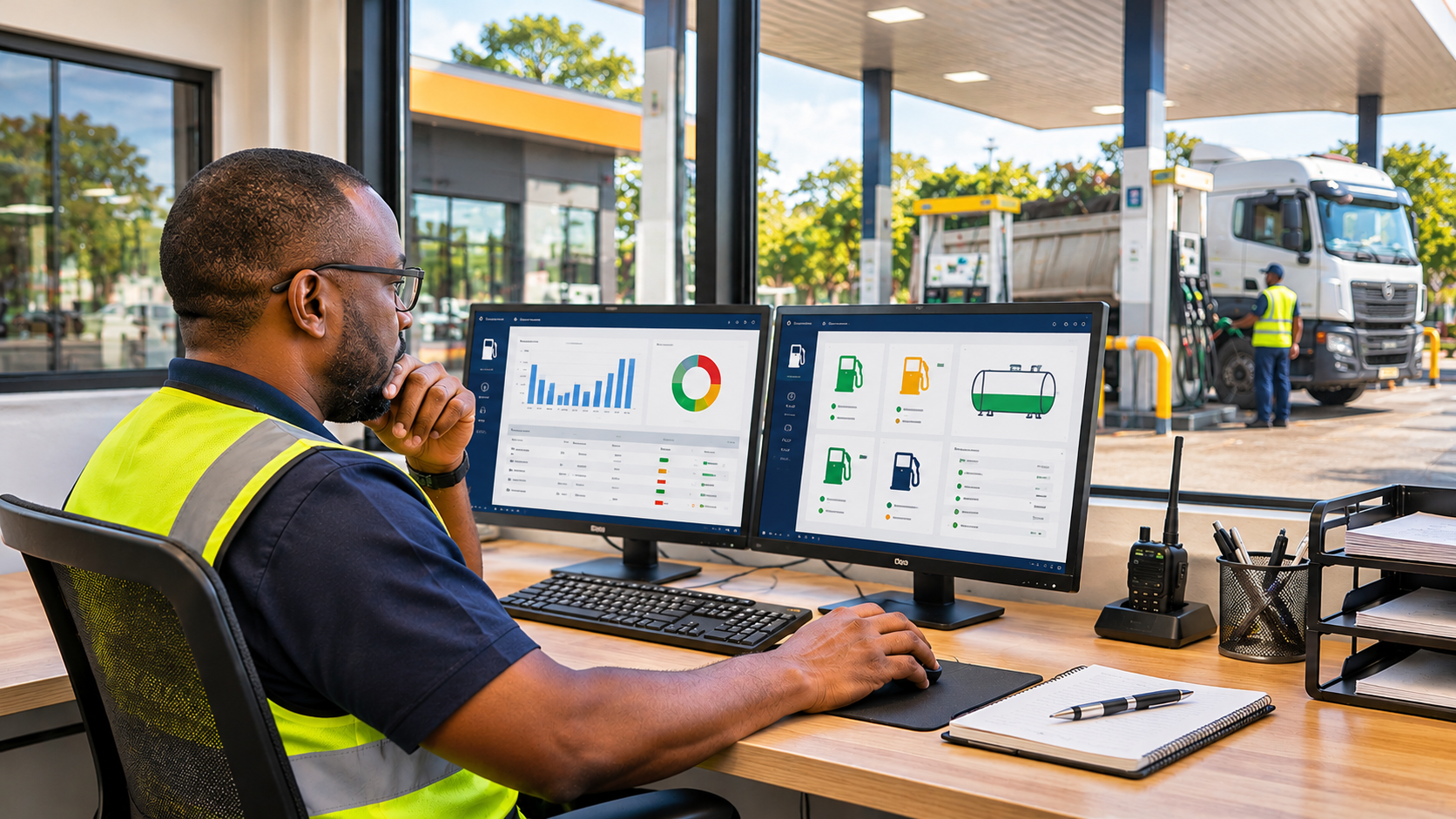
A forecourt can receive a fuel delivery, record a full day of sales and still end the month unable to explain why the tank reading is lower than the books say. For station owners, that gap is the real problem. A petrol station management system exists to close it, by connecting deliveries, tank levels, pump dispensing and sales records so that differences surface early. SMARTFUEL, a South African fuel-management company with over 20 years in the market, works on this problem at forecourts and other fuel sites.
Seeing stock, pumps and exceptions in one dashboard is a sound goal. Whether a single screen can deliver it depends on the equipment, integrations and configuration at each site. This guide explains the concepts first, then where specific tools fit.
Table of Contents
What Is a Petrol Station Management System?
A petrol station management system is a combination of software, and often hardware, that helps an operator see and control what happens to fuel from delivery to sale. In practice the term covers several different functions, and suppliers do not all offer all of them:
- Petrol station management software: the reporting and administration layer that brings records together.
- Forecourt management system: controls and monitors the forecourt equipment, such as dispensers.
- Point-of-sale (POS) software: records sales at the till or pump, including payments.
- Wet-stock management and reconciliation: compares fuel received, fuel issued and fuel measured in the tanks. “Wet stock” is the fuel; “dry stock” is shop goods.
- Fuel monitoring and dispensing-control systems: measure tank levels and control or record who dispenses fuel.
These functions can work together, but they are not automatically the same product. Linking them may need compatible pumps, tank probes, controllers, network connections or integration with your existing POS and accounting software. Always ask which parts are included and which need separate equipment.
Common Petrol Station Management Challenges in South Africa
These are possible operational challenges, not problems every station has:
- Hard-to-reconcile records. Deliveries, tank readings, dispensing and sales often sit in different places.
- Unexplained stock variances. The expected and measured figures differ and nobody can say why.
- Limited visibility across sites. Owners of several stations may see each site’s numbers only after the month ends.
- Manual reporting. Paper logs and spreadsheets create inconsistent records.
- Unauthorised dispensing. Fuel issued outside normal procedures is difficult to trace without records.
- Slow detection. Unusual activity found weeks later is harder to investigate.
- Equipment and integration limits. Older pumps, probes or networks may restrict what data is available.
9 Important Features to Look for in Petrol Station Management Software
Use this table when comparing any petrol station management system. No supplier is assumed to offer all nine. Several features depend on compatible equipment, integrations or configuration.
| Feature | What it should help you do | Why it matters | Ask the provider |
|---|---|---|---|
| 1. Fuel stock visibility | See current tank levels, ideally by tank and grade | Early warning of low stock and unusual drops | How often do readings update? What probes are needed? |
| 2. Delivery recording | Record what was ordered, delivered and measured on receipt | Delivery errors are a common source of variances | Can delivery notes be captured and compared to tank gains? |
| 3. Stock reconciliation | Compare expected stock with measured stock | Turns raw data into a clear variance to investigate | Which records feed the calculation? Can I see daily and monthly views? |
| 4. Pump and dispensing controls | Authorise, restrict or record dispensing | Reduces uncontrolled fuel issue | What happens at the pump if the system goes offline? |
| 5. User accountability | Link activity to a user, attendant or account where supported | Makes investigations factual | Which identifiers are supported at my site? |
| 6. Exception alerts and reporting | Flag unusual patterns and produce reports | Saves time reviewing every transaction | Who sets the alert rules? Can reports be exported? |
| 7. Multi-site visibility | Compare sites using consistent reports | Shows recurring issues across a group | Is reporting consolidated, and how is data quality handled between sites? |
| 8. Data access and integrations | Share data with POS, accounting or other tools | Avoids double capture | Which integrations are proven, and which need custom work? |
| 9. Implementation, training and support | Install, train staff and fix faults quickly | A good system fails without consistent use | What is included, what is extra, and what is the response time? |
What depends on equipment or setup: features 1, 4 and 5 usually depend on compatible tanks, probes, dispensers and controllers. Features 6 to 8 depend on how data is configured and connected. Ask for compatibility to be confirmed in writing for your site.
How Petrol Station Stock Reconciliation Works
Fuel stock reconciliation compares what the records say should be in a tank with what is physically measured. The basic process:
- Record opening stock or the starting tank measurement.
- Record deliveries received.
- Obtain dispensing or sales information from the relevant systems.
- Account for legitimate stock movements and adjustments.
- Compare expected closing stock with measured closing stock.
- Investigate material or recurring differences.
Two simplified formulas:
Expected closing stock = opening stock + deliveries received – recorded fuel issued
Stock variance = measured closing stock – expected closing stock
These are simplified operational calculations. Transfers, returns, adjustments, measurement conventions and other legitimate movements may also need to be included.

A negative variance means less fuel was measured than expected. A positive variance means more was measured. Either is a reason to investigate. A variance is not proof of theft. Measurement errors, timing differences between readings and sales, equipment faults, inaccurate delivery records and data-quality problems can all cause discrepancies. There is no universal acceptable variance figure, so set thresholds with your supplier, your fuel wholesaler and your own history.
For a step-by-step walkthrough of the method, see SMARTFUEL’s guide to fuel reconciliation.
How Pump Controls Improve Fuel Accountability
In a petrol station management system, pump controls help an operator decide who may dispense fuel and keep a record of what was dispensed. Where supported, this can include:
- Authorised dispensing: the pump only releases fuel after a valid authorisation.
- User permissions: different people have different rights.
- Traceability: identifying who or which account initiated a dispensing event.
- Activity review: looking at dispensing records by time, pump, user or account.
- Investigation of unusual transactions: checking activity that falls outside normal procedure.
Authorisation can use RFID tags, PINs or one-time passwords (OTPs), depending on the system and installation. Not every method is available on every site, so confirm which options your equipment supports.
Pump authorisation is not the same as payment processing or a cashier POS. A system can control who dispenses without handling card payments, and a POS can record a sale without controlling the pump.
Fuel Theft Prevention: What Technology Can and Cannot Do
Better records, dispensing controls and reconciliation make it easier to spot suspicious patterns. Examples worth reviewing:
- Repeated stock discrepancies on the same tank or shift.
- Dispensing records that do not match expected activity.
- Unexplained stock changes outside delivery times.
- Delivery documentation that does not match the quantity measured into the tank.
- Activity outside expected procedures, where the relevant data is available.
Before drawing conclusions, check the basics: Were tank dips or probe readings taken correctly? Was a delivery recorded late? Are meters calibrated? Was there a leak, a pump fault or a data-entry error? Only after ruling out the ordinary explanations should a variance be treated as a possible loss event.
A petrol station management system can support prevention and investigation. It cannot guarantee that theft will never occur, and it works only when staff follow the procedures around it.
Managing Multiple Petrol Stations from One Central View
Where a petrol station management system supports it, central reporting lets an owner or head-office manager:
- Compare site-level reports on a consistent basis.
- Spot recurring discrepancies at particular sites.
- Apply the same operating procedures everywhere.
- Manage user permissions consistently.
- Escalate issues for investigation quickly.
Sites rarely match each other. Differences in pumps, tank probes, connectivity and record-keeping affect data quality, so a variance comparison between two stations is only fair when you understand those differences.
How to Choose the Right Petrol Station Management System in South Africa
Use this checklist when speaking to suppliers:
- Does the system solve your main operational problem?
- Is it compatible with your existing tanks and pumps?
- What equipment or installation is required?
- Can it integrate with your POS or accounting system if you need that?
- How often is information updated?
- What happens during connectivity or equipment failure?
- Can reports be exported?
- How are user permissions managed?
- What training and ongoing support are included?
- What are the total implementation and operating costs?
Ask for a demonstration built around your own workflow, such as a delivery, a shift change and a month-end reconciliation, and confirm compatibility before you buy. For wider context on the local fuel sector, see the Fuels Industry Association of South Africa (FIASA, formerly SAPIA).
How SMARTFUEL Supports Better Fuel Management
SMARTFUEL describes its forecourt fuel management solutions as covering several of the areas above. According to the SMARTFUEL website, these include:
- Live tank readings with per-transaction reconciliation, intended to flag discrepancies.
- Tracking fuel from the tank to the attendant to the transaction and payment method.
- Fuel quality monitoring.
- Pre-authorised account-customer control at pump level.
- Shop point of sale with stock management, and reporting on staff productivity.
- Wireless connection and lightning-proof technology, aimed at easier installation and reliable operation.
It is worth being clear about scope. Fuel monitoring, dispensing authorisation, reconciliation and a full station and POS platform are different things, and what is delivered at your site depends on your equipment and requirements. Ask SMARTFUEL to confirm what would be included at your station, which authorisation methods apply, and how reporting would work if you run more than one site.
A Practical Petrol Station Stock and Pump Control Checklist
A petrol station management system only works when people follow consistent habits. Use this checklist at every site:
- Keep delivery records complete.
- Record tank measurements consistently.
- Reconcile expected and measured stock.
- Investigate unexplained differences.
- Maintain appropriate dispensing authorisation.
- Review user permissions.
- Maintain equipment and measurement systems.
- Review recurring exceptions.
- Document investigations and legitimate adjustments.
- Train staff on operational procedures.
Conclusion: Better Visibility Supports Better Station Control
Reliable delivery records, regular reconciliation, sensible dispensing controls and timely investigation work together. None of them removes the need for good procedures, but each makes unexplained differences easier to see and explain. If you are weighing options for one site or several, start with your main operational problem and test every petrol station management system against your own workflow.
To discuss your station’s requirements, explore the fuel-management solutions at SMARTFUEL and speak to the team about what suits your forecourt.
Frequently Asked Questions
What is a petrol station management system?
It is a combination of software and often hardware that helps an operator monitor fuel stock, deliveries, dispensing and sales. Exact features vary by supplier and installation.
How does petrol station software help with stock control?
It brings delivery, tank-level and dispensing records together so expected stock can be compared with measured stock, and differences can be investigated.
Can a fuel-management system detect petrol theft?
It can help flag unusual patterns and support investigations through better records and dispensing controls. A stock variance is not proof of theft, and no system can guarantee theft will never occur.
What is the difference between POS software and fuel stock management?
POS software records sales and payments. Fuel stock management tracks fuel received, issued and held in the tanks. They can be linked, but they are different functions.
Can petrol station software monitor pumps and tank levels?
Some systems can, provided compatible tank probes, dispensers and controllers are installed. Confirm compatibility with your equipment.
Can one system manage multiple petrol stations?
Some systems offer reporting across sites. Check how data is consolidated and how differences in equipment between sites are handled.
What should a South African petrol station check before buying management software?
Check compatibility with existing tanks and pumps, installation needs, integration with POS or accounting, behaviour during connectivity failure, report exports, user permissions, support and total cost. Ask for a demonstration using your own workflow.