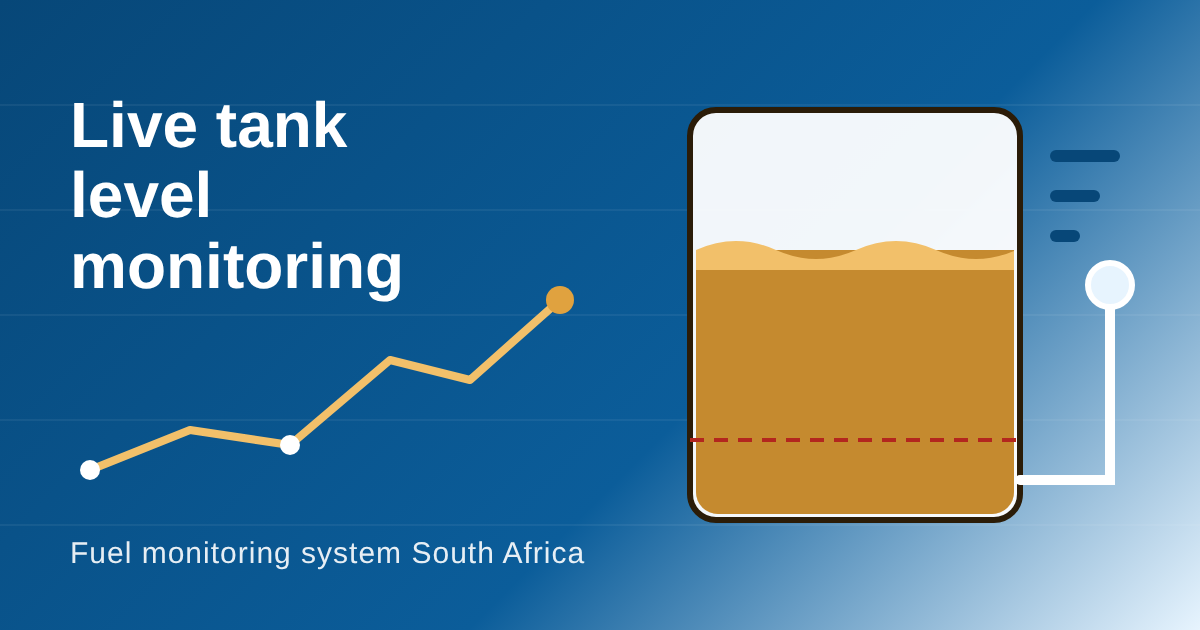
A fuel monitoring system South Africa operators can rely on does one job well: it shows how much diesel is in every tank right now, not at the next dip reading. Whether you run a farm, a mine, a depot or a fleet, a modern fuel management system starts with that live number.
Diesel is a large cost line. Webfleet states that diesel accounts for up to 30 to 40% of total operating costs for many fleets, and South African rebate rules expect claimants to account for every litre. This guide explains how real-time tank level monitoring works, what sensors can and cannot do, and when it is not worth buying.
Key takeaways
- Real-time tank level monitoring reads fuel level through a sensor and sends it to a dashboard, so changes can be seen as they happen.
- Sensor type matters: Navixy puts float gauge error at 10 to 20%, against 1 to 2% for added capacitive or ultrasonic sensors on vehicles.
- Alerts on sudden drops detect theft and leaks. They do not stop them, so pair monitoring with physical protection.
- Tank data supports SARS diesel rebate records but does not replace a compliant logbook.
- A single small tank with supervised daily dips may not need monitoring at all.
What is a fuel monitoring system and how does real-time tank level monitoring work?
A fuel monitoring system measures how much fuel is in a tank with a level sensor, then sends that reading to a dashboard through a controller and a data link. Because readings arrive continuously, deliveries, normal use, sudden drops and possible leaks show up as events instead of surprises at month end.
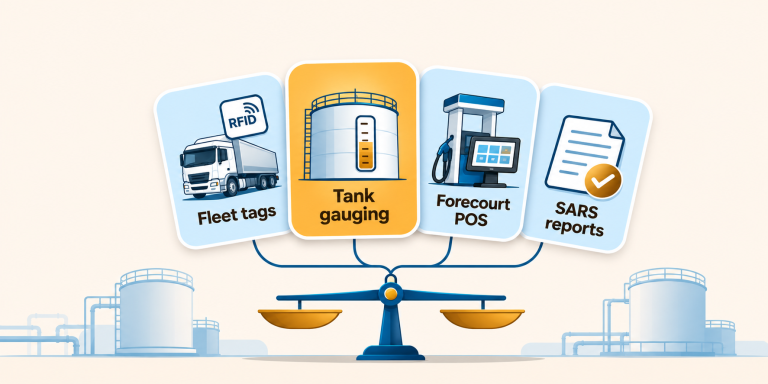
Most systems share four parts: a sensor in or on the tank, a controller or gateway that reads it, a data link, and software that stores readings and sends alerts. Tank level monitoring is one layer of a wider fuel management system, which can also control who dispenses fuel and reconcile the numbers.
How do tank level sensors measure fuel: float, capacitive, ultrasonic or hydrostatic?
The sensor decides how far you can trust the number. Navixy explains that a float sensor moves a float on a potentiometer and gives only an approximate reading, with a relative error of 10 to 20%. Added capacitive or ultrasonic sensors are listed at 1 to 2%.
Chart 1: Published sensor error ranges, in per cent
Source: Navixy, types of fuel level sensors. Figures relate to vehicle tanks.
Those figures describe sensors on vehicle tanks. Bulk tanks on farms, mines and depots differ in size and shape, so ask any supplier for accuracy figures for your tank and fuel, and how the system is calibrated.
| Sensor | How it measures | Watch out for |
|---|---|---|
| Float | A float moves a potentiometer as the level changes | Approximate reading, 10 to 20% error (Navixy) |
| Capacitive | Fuel changes the capacitance between two tubes | Tank height and shape must be known before installation (Navixy) |
| Ultrasonic | Times the echo from the fuel surface | Dirt and water at the tank bottom distort the signal, and baffles affect it (Navixy) |
| Hydrostatic | Reads the pressure of the fuel column above the sensor (Sensors One) | Ask how it is calibrated for diesel and your tank depth |
What can real-time tank monitoring show that a dipstick cannot?
A dipstick gives one number at one moment. A monitored tank gives a trace, and the shape of the trace tells the story. A steady slope is normal use, a step up is a delivery, and a sudden step down outside working hours deserves a question.
Chart 2: One illustrative day on a monitored tank
1 of 11 drops flagged. Largest drop not flagged: 500 litres.
Balanced for this day: only the large drop is flagged.
Illustrative data, not real readings. Real systems also look at timing and dispensing records.
Move the slider and you see the trade-off every site faces. Set the alert too low and normal use floods you with false alarms. Set it too high and a real loss slips through.
Webfleet lists the usual theft routes as siphoning during overnight stops, fuel card misuse, manipulated fuel logs and tampering with tanks, caps or lines. It recommends real-time level data with alerts for sudden drops, plus physical protection and clear refuelling rules. IFS notes there is no single national dataset of diesel theft, so published loss figures are estimates. For site measures, see our fuel theft prevention page.
How does the reading get from the tank to your phone?
The sensor reading passes through a controller, over a network link, to software that stores it and sends alerts. The weak point on remote farms and mines is often the link, so ask whether readings are stored on site and uploaded when the signal returns.
Chart 3: Typical path of a tank reading
Illustrative generic data path. Components vary by supplier.
Level alone is only a percentage. Capacity and daily use turn it into days of cover, which is what a depot manager needs to schedule a delivery. Try the calculator below. For tank set-up and bowser control, see our guide to bulk diesel storage management.
Chart 4: Turn a level reading into days of cover
Fuel in tank: 12 400 litres
Days of cover: 15.5
Above the 20% low-level alert.
Illustrative calculator with example values. Replace them with your own.
How does tank monitoring support SARS diesel rebate records?
Primary producers claiming the diesel rebate must back every litre with records. Farmers Weekly reports two 2025 refund rejections: in Sandbaken Boerdery the logbooks were incomplete, and in Naudé the diesel was not bought in the applicant’s name and the logbooks did not specify the farming tasks. The Citizen reports that mining company Assmang was ordered to repay almost R40 million in refunds and interest.
Chart 5: Diesel rebate record keeping timeline
- Earlier, date not statedAssmang was ordered to repay almost R40 million in refunds and interest over inadequate record keeping (The Citizen).
- January 2025Sandbaken Boerdery: SARS denied a refund because diesel usage logbooks were incomplete (Farmers Weekly).
- February 2025Naudé: refund denied. The diesel was not bought in the applicant’s name and logbooks did not name the farming tasks (Farmers Weekly).
- 30 September 2025PKF publishes what compliant tank and usage logbooks must include.
- April 2026On-land diesel users can claim 100% of the levies, up from 80% (The Citizen).
Sources: The Citizen, Farmers Weekly, PKF. Check current rules with SARS.
PKF lists seven items for a tank storage logbook, from capacity and location to monthly opening and closing balances. A monitored tank can supply fill, removal and balance data. The reasons for each removal still need a person or a dispensing record.
Chart 6: What a tank storage logbook asks for
Source: PKF, 30 September 2025. Tags are our reading, not tax advice.
The Citizen also reports that the refundable portion for on-land users rose from 80% to 100% in April, and that logbooks move from daily to monthly records under the amended legislation. Rules change, so confirm them with SARS or a tax adviser. Sector pages for agricultural fuel management and mining fuel management explain how that works on site, and our guide to fuel reconciliation shows how tank data feeds the reconciliation.
Checklist: what should you specify before buying a fuel monitoring system?
- List every tank with its capacity, shape, fuel type and location.
- Ask for accuracy figures for your tank type and how the sensor is calibrated.
- Confirm how readings travel from a weak-signal site, and whether they are stored when the link drops.
- Decide which events need alerts: sudden drop, low level, delivery detected.
- Name who receives each alert and who must respond.
- Check that reports show monthly opening and closing balances for rebate records.
- Ask how deliveries are matched to supplier invoices.
- Plan physical protection such as lockable caps and tank guards.
- Agree a commissioning test: dip the tank and compare it with the dashboard.
When is tank level monitoring not the right move?
Monitoring is not always the answer. Hold off if one of these describes you:
- You have one small tank, low use and a supervised daily dip routine that is working.
- Your losses happen at the pump, through fuel cards or edited logs. A level sensor will not show who dispensed what, so you need dispensing control and reconciliation first.
- Nobody will act on alerts. An alert that no one answers is only decoration.
- Your tank has dirt, water or baffles that suit your chosen sensor poorly. Fix the tank or pick another sensor type.
Fuel monitoring system South Africa: frequently asked questions
How accurate is a tank level sensor?
It depends on the sensor type and how it is installed. Navixy gives a relative error of 10 to 20% for factory float sensors in vehicles and 1 to 2% for added capacitive or ultrasonic sensors. Bulk tanks differ, so ask your supplier for accuracy figures for your tank shape and fuel, and test the dashboard against a manual dip after installation.
Can a fuel monitoring system stop diesel theft?
It detects theft rather than stopping it. Real-time level data with alerts for sudden drops lets you respond quickly, which Webfleet recommends alongside physical protection such as lockable caps and tank guards. Monitoring also shows nothing about theft through fuel cards or edited logs, so combine it with dispensing controls and regular reconciliation.
Does tank monitoring replace the SARS diesel logbook?
No. PKF explains that rebate claims must be backed by accurate logbooks that account for every litre, including tank storage records and usage records. A monitoring system can supply fill, removal and balance data, but the logbook still needs the reasons for removal and the qualifying activity. Confirm current requirements with SARS or a tax adviser.
What is the difference between tank monitoring and a fuel management system?
Tank monitoring answers one question: how much fuel is in the tank. A fuel management system goes further by recording who dispensed fuel, into which vehicle or machine, and how that compares with deliveries and tank levels. Many sites start with tank monitoring and add dispensing control and reconciliation as their needs grow.
Is tank level monitoring worth it for a small farm or depot?
It depends on volume, theft exposure and whether you claim the diesel rebate. A single small tank with a supervised dip routine may not need it. Add up the litres you cannot explain over a few months, then compare that value with the quoted cost. Ask suppliers for a written quote rather than relying on generic savings claims.
What happens if the connection drops at a remote site?
That depends on the product, so ask before you buy. Look for a controller that stores readings locally and sends them when the link returns, and confirm what alerts you receive if the site goes offline. Remote farms and mines often have patchy coverage, so ask the supplier how they handle sites like yours.
Talk to a South African fuel management specialist
If you want accurate tank levels, alerts and records you can stand behind, review our fuel theft prevention and monitoring solutions. SmartFuel is a South African fuel management company with 26 years of experience, trusted at 600+ sites and headquartered in Johannesburg.
Ready to talk about your tanks? Contact the SmartFuel team or call +27 11 615 3437.
Sources
- Navixy: Types of fuel level sensors
- Webfleet: Fuel theft prevention for fleet vehicles in South Africa
- PKF: SARS on the attack, diesel refunds (30 September 2025)
- The Citizen: Diesel rebate reforms, Treasury removes 80% cap
- Farmers Weekly: Diesel refunds, why farmers struggle to claim
- IFS: Diesel theft prevention
- Sensors One: Liquid level sensors