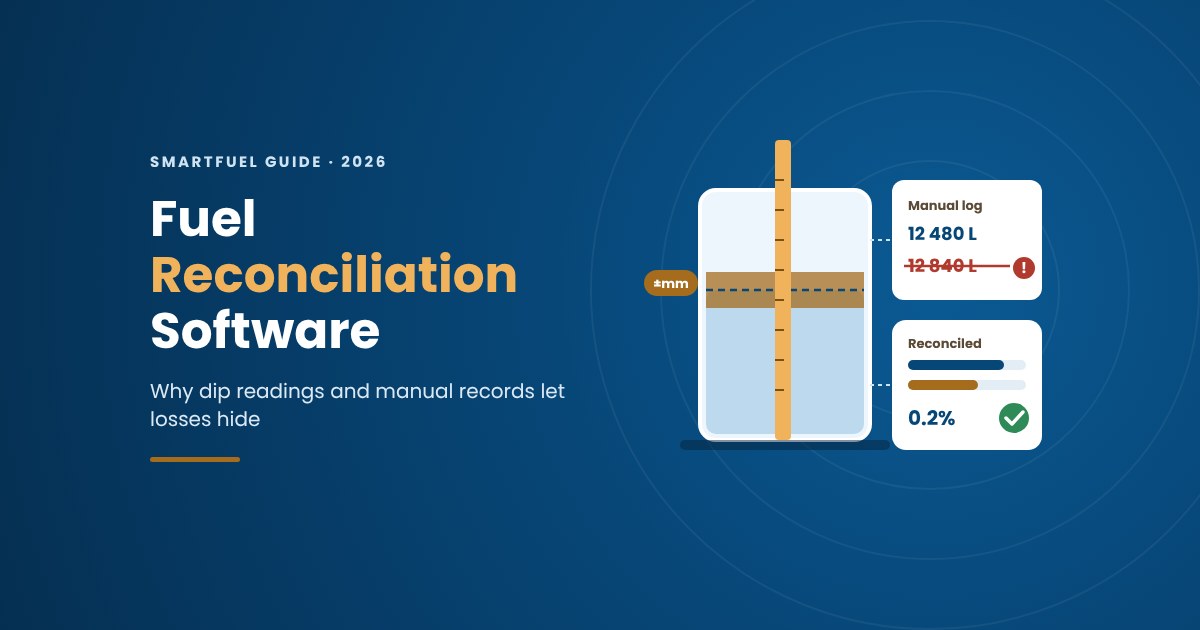
Fuel reconciliation software matches what your tanks should hold against what the meters, delivery notes and dips say happened, and it matters because dip readings and manual records each leave gaps where losses can hide. This guide explains where both fail, what the software changes and when it is not the right move, with help from a South African fuel management specialist if you want it.
We reviewed vendor, government and industry sources and name each one. Several vendor pages are marketing claims, and we have not tested any product. The chart figures are illustrative, so replace them with your own.
Key takeaways
- A dip gives a level, and a tank chart turns it into litres, so chart quality, temperature and timing all move the answer.
- Manual records add typing slips and delay, and month-end totals can hide offsetting losses.
- Reconciliation software captures opening stock, deliveries, dispensing and closing stock, then flags gaps outside your tolerance.
- Dips still matter as a physical check, but they should not be the whole system.
- Fix tank charts and meter proving first, because software cannot repair bad inputs.
What is fuel reconciliation software, and why do dips and manual records fail?
Fuel reconciliation software compares opening stock, deliveries, dispensed litres and closing stock, then flags the gap against a tolerance you set. Dip readings and manual records fail because every step relies on a person reading, writing and timing correctly, so errors and losses stay hidden until the next audit.
Where do dip readings go wrong?
Dipping is a standard method, but it is a chain of small judgements. Instrumentation Tools notes that dip accuracy and consistency depend heavily on the operator, and that wind and cold can affect the result.
The tank chart is part of the measurement
A dip gives a level, and a tank chart converts it to litres. Veeder-Root points out that a stick or probe reading is only as good as the chart behind it. The UK HMRC oils manual adds that sinking floors or barrelling need a new calibration table, and that water at the bottom must be deducted from the dip volume.
Millimetres become litres
Chart 1 shows the geometry for a simple upright cylindrical tank. At 2.5 metres wide, each millimetre of level is about 4.9 litres, so a few millimetres of reading error moves the balance by tens of litres at each reading. HMRC expects new depot gauges to agree with manual dips within 5 mm, a reminder that even regulators accept some spread.
Chart 1: What a dip reading error is worth in litres
Litres in each millimetre of level: 0 L
Error on one reading: 0 L
Opening plus closing dip, worst case: 0 L, or 0% of a day’s throughput
Illustrative geometry for an upright cylindrical tank. The band is drawn larger than true scale so you can see it. Horizontal and irregular tanks depend on the tank chart.
Temperature changes the litres
Diesel expands when warm and contracts when cold. UK guidance on standard temperature accounting converts volumes to 15 °C, and a Measurement Canada table gives a diesel factor of 0.9847 at 33 °C, roughly 1.5% fewer litres at 15 °C. Gilbarco says tank calibration, delivery shortages and temperature changes have the largest impact on variance.
Chart 2: The same diesel, measured at different temperatures
Illustrative. Straight line between two published diesel factors (Measurement Canada: 1.0168 at -5 °C and 0.9847 at 33 °C). Use the official tables for real accounts.
Timing gaps
Dips only help if they line up with sales records. An Australian petrol retail magazine advises recording sales and dip readings at the same time every day, ideally with no fuel sold in between. Government Fleet magazine makes the same point for deliveries: measurements need a window with no dispensing or deliveries.
Why do manual records and spreadsheets fail?
Gilbarco compares manual reconciliation to accounting: two sets of figures must balance, and human error can occur at any step. In South Africa the weak link is often the spreadsheet itself. Infrastructure News reported that an Excel spreadsheet is the most common fuel management system in the country, sometimes even where a sophisticated system has been installed.
The delay is the real cost
A weekly or monthly review is a delay. FleetRabbit, a vendor, contrasts manual reconciliation, discovered at the next audit and often months later, with flags on the day a variance appears. That is a marketing comparison, not a measured result, but the arithmetic in Chart 3 holds for any loss rate you choose.
Chart 3: How long a loss runs before anyone sees it
Largest build-up before it is caught:
Illustrative. Fixed vertical scale: the top is 90 days of loss, so frequent checks show as small teeth. The price is a placeholder, so replace it with yours.
One slip moves the balance
Typing 12 840 for 12 480 puts 360 litres on the wrong side of the ledger. Chart 4 tests common slips against your own tolerance.
Chart 4: How one slip of the pen moves the balance
Illustrative slips applied to your own numbers. The bar shows the gap as a share of your tolerance.
Month-end totals hide offsetting days
A short delivery on one day and an unrecorded fill on another can cancel out in a monthly total. Chart 5 uses illustrative data for a month that nets to almost nothing while four days sit well outside a 0.5% tolerance. Heavy Vehicle Inspection also warns against treating every variance as theft, so each flagged day needs a recorded cause.
Chart 5: A month that balances while four days do not
Illustrative data: daily variance as a percentage of that day’s throughput. Real months differ.
What does fuel reconciliation software do differently?
It replaces typed figures with captured ones. Gilbarco lists what must be tracked: opening inventory, deliveries, closing inventory, book sales and recorded sales. With gauges and pump data feeding the system, those figures are logged and compared automatically instead of retyped.
- Delivery checks. FleetRabbit says incoming volume should be checked against the delivery document and the tank level rise, so a short delivery shows up at the source.
- Tolerance and exceptions. You set the band, and only gaps outside it need attention.
- A written trail. HVI suggests recording the date, tank or asset, expected and actual litres, variance %, probable cause, evidence, reviewer, corrective action and closure date. Gilbarco’s SARS rebate guide lists variance, variance % and an explanation when outside tolerance.
- Dips as a check. FMT says its virtual tank feature recalibrates the calculated level when a manual dip is performed, so dips become verification, not the whole system.
Software does not repair bad inputs. A wrong tank chart, an unproven meter or a missing delivery still distort the result. Our fuel reconciliation explained page covers the basics, and fuel theft prevention covers what to do when the variance is real.
Manual dips versus reconciliation software: how do they compare?
The middle column reflects typical vendor descriptions, so check each point in a demo.
| Aspect | Manual dips and spreadsheet | Gauge-based reconciliation software | SmartFuel (to confirm per site) |
|---|---|---|---|
| Tank level | A person dips with a stick and a chart | Gauge or probe feeds the system, with dips as a check | Real-time wireless level monitoring; confirm the sensor type per site |
| Deliveries | Delivery note typed in | Compared with the tank level rise | Chain of custody tracking; confirm the delivery workflow |
| Dispensing | Issue book or totaliser typed in | Pump transactions captured electronically | Confirm the pump hardware for your site |
| Temperature | Usually ignored | Some gauges report it; ask about 15 °C correction | Ask whether volumes are temperature corrected |
| Review cadence | Weekly or monthly, when someone has time | Daily or by shift, vendor dependent | Ask which cadence your setup supports |
| Audit trail | Edits and handwriting | Logged variances with reasons | SARS diesel rebate compliance records; confirm the report format |
Checklist: moving from dips and spreadsheets to reconciliation
- Check the tank chart for each tank, and date it.
- Prove each pump meter against a measured vessel.
- Dip at a fixed time, with no dispensing or deliveries during the dip.
- Record each delivery quantity, temperature and the tank level rise.
- Write down a tolerance you can defend.
- Run dips and the software side by side for a month before trusting either.
- Record a probable cause and evidence for every variance.
- Review exceptions weekly and patterns monthly.
When is fuel reconciliation software not the right move?
- You run one small tank, and a disciplined weekly dip with a current tank chart already balances inside your tolerance.
- The tank chart is out of date or the pump meter has never been proven. Fix measurement first.
- Nobody owns the exceptions. Flags that no one reads add cost, not control.
- Your losses happen in vehicle tanks or on the road, which a bulk tank reconciliation cannot see. SmartFuel’s mining and logistics pages show how the chain differs by sector.
Fuel reconciliation software: frequently asked questions
What is fuel reconciliation software?
Fuel reconciliation software compares opening stock, deliveries, dispensed litres and closing stock for each tank, then flags any gap outside a tolerance you set. Systems differ in how they capture data, from gauge probes to pump transactions, and in how often they reconcile. Ask any vendor how it handles temperature, tank charts and delivery checks before you buy.
Why are manual dip readings unreliable?
A dip depends on the operator, the weather, the tank chart and the timing against sales. Instrumentation Tools says accuracy depends heavily on the operator, and Veeder-Root notes a reading is only as good as its chart. Temperature, water at the bottom and a dip taken while fuel is moving add further error.
How accurate is a manual tank dip?
It depends on the tank, the stick, the chart and the person reading it. As a reference point, the UK HMRC oils manual expects new automatic depot gauges to agree with manual dips within 5 mm. In litres that depends on tank width, so work out your litres per millimetre and compare it with your tolerance.
How often should you reconcile fuel?
One municipal fleet fuel guide from Heavy Vehicle Inspection suggests weekly tank-level reconciliation against dispensing and deliveries, plus a monthly variance review. Software can reconcile daily or by shift, depending on the system. A longer interval simply lets a loss run for longer before anyone sees it.
Does reconciliation software replace dipping?
Not entirely. Dips remain a useful physical check on gauges and calculated levels. FMT’s virtual tank feature, for example, recalibrates its calculated level when a manual dip is performed. Keep a current tank chart, dip at a fixed time, and let the software do the matching, the arithmetic and the exception trail.
Is a fuel variance always theft?
No. Gilbarco lists tank calibration, delivery shortages and temperature changes as large drivers of variance, and meter over-dispensing as the most immediate saving. Timing gaps and entry errors add more. Record a probable cause and evidence for each variance, and investigate patterns, not single days.
Move from dips to a reconciled record
If you want gauge-based reconciliation designed around your tanks, start with SmartFuel’s fuel management system provider guide. SmartFuel is a South African fuel management company with 26 years of experience, trusted at 600+ sites and based in Johannesburg.
Ready to test your current records? Contact the SmartFuel team or call +27 11 615 3437.
Sources
- Infrastructure News: When fuel goes missing
- Instrumentation Tools: Dip tape level measurement
- Veeder-Root: Inaccurate tank charts and fuel variance
- UK HMRC oils manual: Tank dipping
- UK HMRC oils manual: Automatic level gauges
- UK guidance: Standard temperature accounting (PDF)
- Measurement Canada: Diesel volume correction factors (PDF)
- Gilbarco: Wetstock inventory automation
- Gilbarco: Where are you losing fuel
- Gilbarco: Manual versus automated reconciliation
- Gilbarco: SARS rebate ROI calculation (PDF)
- ACAP: Tips for accurate SIR data
- Government Fleet: A balanced fuel budget
- FleetRabbit: Mining fuel reconciliation software
- HVI: Mining fuel reconciliation guide
- FMT: Pro reports