Diesel is one of the largest line items in a South African fleet budget, and a rising invoice rarely explains why it is rising. Fleet fuel management is the practice of controlling who can take fuel, recording where every litre goes, and comparing those records with tank levels, kilometres and engine hours. Providers such as SmartFuel build systems around that idea, but the method matters more than the product. This guide to fleet fuel management South Africa operators can apply sets out the method, shows how to measure results fairly, and explains what the evidence on savings actually supports.
Fleet fuel management South Africa: what it means in practice
Fleet fuel management is the set of controls and records a business uses to authorise fuel use, capture every litre dispensed, and compare those figures with what the tanks, vehicles and machines show. It covers fuel drawn from your own depot tanks as well as fuel bought at public stations, although the tools differ for each. If you are still deciding between vehicle-level tracking and depot-level control, this comparison of car fuel management and fleet fuel management explains the difference.
Why fleet fuel costs are hard to control
Three numbers should agree: fuel purchased, fuel dispensed and fuel consumed. In many fleets they do not, and nobody can say which stage the gap sits in. The usual causes are ordinary ones:
- Paper registers and spreadsheets kept differently at each depot.
- Fuel drawn without a record of which vehicle or driver took it.
- Consumption compared only at month end, when a small daily loss has already grown.
- Diesel price movements that hide changes in how much fuel is actually used.
A 2016 paper from North-West University presented at the SAIIE27 conference described fuel as the biggest contributor to road transport operating costs, pointing to diesel prices and to fuel theft. A MiX Telematics Africa director has also described fuel theft as a significant concern for long-distance transporters across Africa.
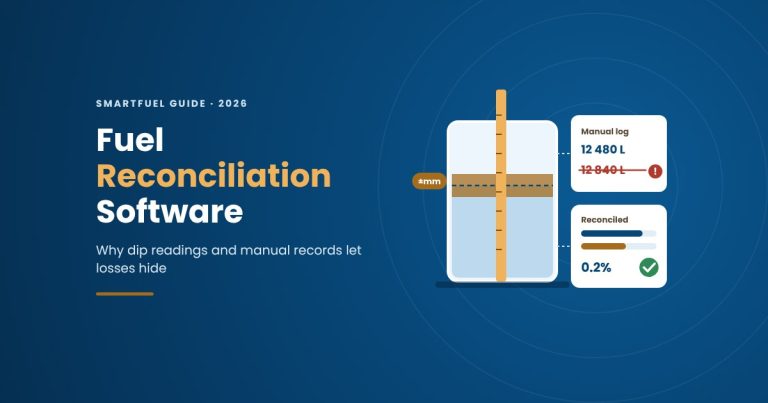
Not every gap is theft. Temperature changes, meter tolerances and timing errors all produce small variances, which is why the first job is to establish what normal looks like for each tank. Our guide to fuel reconciliation shows how to calculate that.
A practical 7-step routine for controlling fleet fuel
No single control stops every loss. The routine below works because each step catches what the others miss.
- Set a baseline. Collect at least 60 to 90 days of data per site and vehicle: litres purchased, litres dispensed, kilometres or engine hours, and price per litre. Without this, you cannot tell later whether anything improved.
- Authorise every fill. Fuel should flow only to an identified vehicle or machine. Decide who can change authorisations and what happens when a tag or card is lost.
- Record automatically. Each transaction should carry the date, time, litres and vehicle. Handwritten records are slow to check and easy to alter.
- Reconcile daily. Compare opening stock plus deliveries minus fuel dispensed with the actual tank reading. Daily checks keep problems small and traceable.
- Compare use with output. Measure litres against kilometres, trips or engine hours so a vehicle that suddenly uses more fuel stands out.
- Investigate exceptions with an owner and a deadline. An alert that nobody acts on protects nothing. Name the person responsible and the time allowed.
- Review monthly by site, vehicle and driver. Look for patterns, such as losses that repeat on the same shift or pump.
For the physical and procedural controls around the pump, see our guide to practical ways to stop fuel theft at a forecourt or depot.
How to measure whether fuel costs are improving
A falling diesel bill does not prove a fleet is using fuel better, and a rising one does not prove it is using it worse. Expenditure moves with the diesel price, kilometres travelled, fleet size and workload as well as with consumption. A fair comparison separates these.
To calculate the change in expenditure between a baseline period and a comparison period:
Percentage change in fuel expenditure =
((baseline expenditure - comparison-period expenditure) / baseline expenditure) x 100
A positive result means spending fell. This measures a change in expenditure, not improved fuel efficiency, and it is not proof that a system or a control caused the change. Use it alongside the measures below, which are related but not interchangeable.
| Measure | What it tells you | What can distort it |
|---|---|---|
| Total diesel expenditure | What the business paid | Diesel price, kilometres, fleet size, workload |
| Litres consumed | Volume used, independent of price | Kilometres, load, routes |
| Litres per 100 km (litres / km x 100), or litres per engine hour for machinery | How efficiently vehicles use fuel | Load, terrain, vehicle mix |
| Unexplained variance (litres and % of fuel dispensed) | Gap between records and tank levels | Meter tolerance, temperature, timing |
| Unauthorised dispensing incidents | Control failures | How incidents are defined and detected |
| Hours spent reconciling records | Administrative effort | Fleet size, process changes |
Illustrative example only. These are not SmartFuel results, and the prices are placeholders. A fleet uses 120,000 litres over 400,000 km at R20.00 per litre in the baseline period, so spend is R2,400,000 and consumption is 30.0 litres per 100 km. In the comparison period it uses 114,000 litres over the same 400,000 km, which is 28.5 litres per 100 km, a 5.0% improvement in consumption. But diesel now costs R21.60 per litre, so spend is R2,462,400. The formula returns a 2.6% increase in expenditure even though the fleet is using fuel more efficiently. Looking only at the bill would give the wrong answer.
Two habits make comparisons fairer. Compare periods of the same length and similar workload, and value the comparison-period litres at the baseline price to see the volume effect on its own.
What the evidence says about fleet fuel savings
You will see claims online that fuel management cuts fuel costs by 10%, 15% or 25%. Before using any such figure in a business case, check who produced it and what it measured. Most published percentages come from software and telematics suppliers, mostly describe fleets outside South Africa, and bundle several measures such as idling reduction, routing, driver coaching and theft prevention. We did not find an independent published measurement of fuel savings from fuel management systems in South African fleets.
The examples below show the kind of results that are documented, and what each one actually measured.
| Source | What was measured | Result | Caveat |
|---|---|---|---|
| Energy Saving Trust and AA DriveTech (2016) | Fuel economy before and after eco-driver coaching, nearly 1,900 sessions in the UK | 9.4% average saving | Measured on a test circuit straight after training. Driver coaching, not fuel controls. |
| Scottish haulage fleet case study | One fleet of 100+ vehicles after investing in driver training | 7% fuel saving in the first year | Single fleet. Driver training. |
| Freight Best Practice case study (2006) | One UK fleet that combined mileage cuts, fuel monitoring and a revised purchasing process | About £5,700 of roughly £36,000 total annual savings came from monitoring and targeting consumption | Single fleet, old. Most of the saving came from cutting mileage. |
| Motive analysis (2022) | Over 800 US commercial fleets, 2020 to 2021 | 13% lower fuel consumption among the top-performing fleets | Supplier’s own analysis. Telematics. Top performers only. |
The pattern is consistent. Savings are real but vary widely, they depend heavily on what a fleet changes and how well it follows through, and savings from stopping theft are a different thing from savings from driver behaviour. Pump control and reconciliation address losses and unaccounted fuel. Coaching and telematics address how vehicles are driven. A fleet that already controls its depot tanks may gain little from tighter pump control, while one that has never reconciled its tanks may find more.
Suppliers, SmartFuel included, publish savings figures on their own websites. Treat all of them as claims to test against your own baseline, not as forecasts.
What a fleet fuel management system can help you see
A system makes the routine above faster and harder to bypass. SmartFuel’s logistics fuel management page describes several capabilities for fleets:
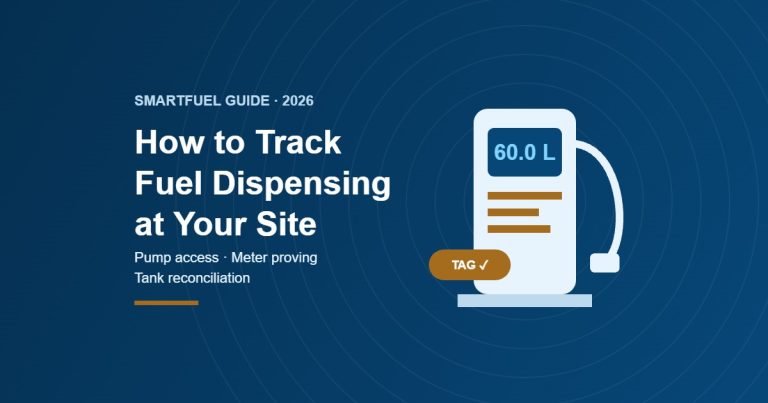
- A tamper-proof RFID tag fitted near each vehicle’s fuel cap, with the pump stopping if the nozzle is removed, so fuel goes only to a recognised vehicle.
- Live tank readings reconciled against each transaction, so a discrepancy appears as a number rather than a suspicion.
- Alerts for suspicious transactions and usage reports per vehicle.
- Integration with fleet platforms such as Key Fleet and MiX Telematics, so fuel data can sit alongside trip and vehicle data.
Features and configurations vary by site, so confirm in writing what applies to yours. A system gives you better records and earlier visibility. It does not eliminate theft, and it does not guarantee a saving. Someone still has to review the exceptions and act on them.
Fuel records, agricultural fleets and SARS diesel refunds
This section applies if your fleet includes qualifying agricultural machinery, or if you provide services to farms. The SARS Diesel Refund Scheme refunds all or part of the general fuel levy and the Road Accident Fund levy for eligible diesel used in listed primary sectors. The sectors named on the SARS scheme page include on-land farming, mining and forestry. General road freight is not among them, so a transport business should not assume it qualifies.
As at 22 October 2026, SARS pages confirm the following:
- Rate. From 1 April 2026, on-land primary sector claimants can claim a refund on 100% of eligible diesel used in qualifying farming, forestry and mining activities, up from 80%. SARS announced this on 13 February 2026 and confirmed it on 20 April 2026.
- Registration. Diesel refund registration is being separated from VAT. A new registration platform on eFiling was implemented on 18 September 2026, and existing users must register on it because registration is not automatic. On 21 October 2026, SARS said taxpayers must have validated and confirmed legal-entity profiles before they can access it.
- Records. Diesel purchase documents and logbook entries showing the actual amounts purchased and used for eligible and non-eligible purposes must be kept for five years.
- No guarantee. A claim is not an entitlement. It can be verified, and any refund paid in error must be repaid with penalties and interest.
Two cautions. First, the SARS scheme page, at the date above, still describes claims being made through the VAT 201 return, so check the page for the current claims process before relying on any summary. Second, how diesel supplied to contractors is treated can decide a claim. Baker McKenzie’s commentary on the Assmang judgment shows the court looking at the substance of contractor arrangements rather than their labels. Take tax advice on those arrangements.
Fuel control helps with the records side. A system that records every litre against a vehicle or machine, together with tank level data, produces the underlying information that logbooks rely on. It does not decide eligibility or guarantee a refund. SmartFuel’s agricultural fuel management page describes an online diesel logbook for farms. For the rules themselves, use the official SARS page and a tax practitioner.
How to choose a fleet fuel management approach
Before asking for quotes, answer these questions in writing:
- Which fuel sources and sites need monitoring: depot tanks, mobile bowsers, public stations?
- What fuel-use information do you have today, and how reliable is it?
- How are dispensing permissions managed, and by whom?
- How are discrepancies investigated, and how fast?
- What reporting do operations and finance each need?
- Which existing systems must the new one connect to?
- What training and process change will your team need?
- How will you measure results over time, using the baseline above?
With those answers, you can compare proposals on equal terms. Our guide to choosing a fuel management provider offers a scoring framework for that comparison.
Frequently asked questions
What is fleet fuel management?
Fleet fuel management is the practice of controlling, recording and reconciling fuel across a fleet’s vehicles, drivers, tanks and sites. It usually combines access controls, transaction records, tank monitoring and regular reporting, so a business can see where every litre went and investigate gaps.
How can a fleet fuel management system help control diesel costs?
It helps by making losses and waste visible earlier. When fuel is authorised per vehicle, recorded automatically and reconciled against tank levels, a discrepancy shows up on the day instead of at month end. The saving still depends on someone acting on the data.
How can businesses identify unexplained fuel discrepancies?
Compare opening stock plus deliveries minus fuel dispensed with the actual tank reading, and do it daily. Build a normal range for each tank over a few weeks, then investigate results outside that range or patterns that repeat on one shift, pump or vehicle. A variance is not proof of theft.
What should a fleet measure to compare fuel consumption fairly?
Measure litres consumed per 100 km, or per engine hour for machinery, alongside total expenditure. Compare periods of similar length and workload, and allow for diesel price changes, fleet size and kilometres travelled. Expenditure alone mixes efficiency with price and volume.
Can fuel management systems help prevent unauthorised fuel dispensing?
They can make it harder and easier to detect. Systems that identify the vehicle before the pump dispenses, and record every transaction, restrict who can take fuel. They work best alongside supervised deliveries, clear procedures and prompt follow-up of exceptions, because no system removes every risk.
How much can a fleet realistically save with fuel management?
There is no verified figure for South African fleets. Published results range from single digits to the mid teens, mostly from suppliers or from driver-training studies outside South Africa. Results depend on current losses, what is changed and how well it is followed. Measure your own baseline first.
How can agricultural businesses maintain traceable diesel records for SARS?
Keep diesel purchase documents and logbook entries showing amounts purchased and used for eligible and non-eligible purposes, and retain them for five years, as SARS requires. Recording each litre against a machine and activity makes this easier. Eligibility depends on SARS rules and your circumstances, so confirm with SARS or a tax practitioner.
How long does it take to see improvements from fuel-management changes?
Discrepancies can become visible within days of daily reconciliation starting, but a fair assessment needs several full reporting periods compared with a baseline. Published examples measure results from immediately after training to a full year. Allow time for procedures to settle before judging results.
Conclusion
Measurable improvement in fleet fuel costs comes from four things working together: controls on who takes fuel, reliable records, regular reconciliation, and people who investigate what the numbers show. Software supports each step, but it does not replace them, and no honest source can promise a fixed percentage in advance. Good fleet fuel management South Africa businesses can sustain starts with your own baseline, a fair comparison, and letting the results guide what you change next.
If you want to see how this could work across your depots and vehicles, you can explore SmartFuel’s fuel management solutions or contact the SmartFuel team to talk through your fuel process and requirements.