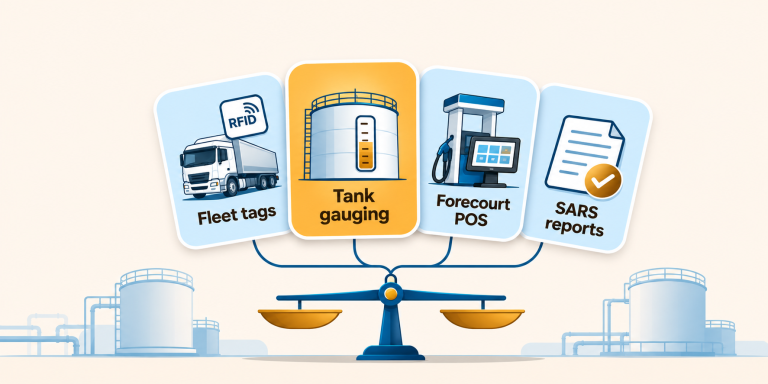
Choosing fuel management software South Africa operators can depend on starts with an awkward truth: most diesel problems are not caused by a missing feature. They come from gaps between the tank, the nozzle, the vehicle and the record. The right system closes those gaps for your sites, and the wrong one simply produces neater spreadsheets. Providers such as SmartFuel build tank and dispensing control around this idea. This guide sets out nine features every fleet, farm and mine should demand, what each one does, and the questions that separate a real capability from a brochure line.
What is fuel management software?
Fuel management software is the system that records, controls and reports how fuel moves through an organisation, from delivery into a tank to dispensing into a specific vehicle or machine. It turns individual fuel transactions into reports that operations and finance teams can check, compare and act on.
The software rarely works alone. In most installations it depends on hardware at the tank and pump, such as level probes, flow meters, pump controllers and identification tags. It also depends on people following a defined process. Software can show that 400 litres are unaccounted for. It cannot explain why unless the tank readings, dispensing records and delivery notes are reliable in the first place.
That distinction matters when you compare fuel management software South Africa suppliers put forward. Ask which functions the software performs, which depend on connected equipment, and which still rely on your own staff and procedures.
Why feature selection matters for South African operations
A long-haul transport depot in Gauteng, a maize farm in the Free State and an opencast mine in Limpopo all burn diesel, but they lose control of it in different ways. A depot may have many drivers using one dispenser. A farm may have tanks kilometres from the farmhouse with weak cellular signal. A mine may move fuel by bowser to machines that never visit a fixed pump.
Power interruptions, lightning, dust, heat and patchy connectivity all affect whether equipment keeps recording. Record-keeping needs also differ. A farm that claims diesel refunds needs records that link fuel to eligible activities, while a fleet operator may care most about litres per kilometre by vehicle. Feature lists for fuel management software South Africa operators receive often ignore these conditions, which is why each feature below comes with questions to put to any provider.
9 fuel management software features to demand
The nine features below form a practical checklist for evaluating fuel management software South Africa providers offer. Not every organisation needs all nine in the same configuration, so treat them as requirements to test against your own sites, equipment and processes.
1. Real-time fuel tank monitoring
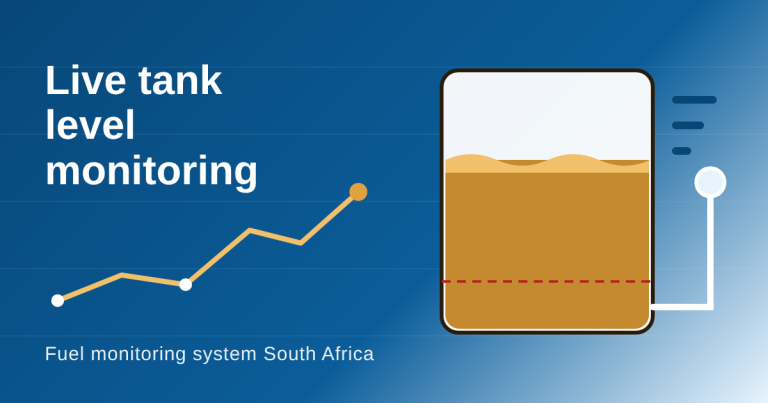
What it does: Tank monitoring uses probes or sensors to report how much fuel is in each tank, ideally close to real time, so you can see deliveries, dispensing and unexplained drops as they happen.
Why it matters: Without reliable tank readings, reconciliation depends on manual dipsticks taken at irregular times. Timely readings let you compare what the tank says against what the pump recorded, which is the foundation for spotting losses. Monitoring improves visibility, but it does not guarantee accurate readings or prevent theft on its own. Probes need correct calibration, and readings can drift with temperature and tank geometry.
What to ask the provider:
- How often are tank readings updated, and what happens when a reading is delayed or missing?
- Which probes or sensors are required, and are they suitable for our tank sizes and shapes?
- How does the system flag a level change that does not match a recorded transaction?
SmartFuel relevance: SmartFuel’s service pages describe live tank readings with per transaction reconciliations intended to detect discrepancies quickly. Confirm the specific probe hardware and update frequency for your tanks during a site assessment.
2. Secure fuel dispensing and user authorisation
What it does: Authorisation controls decide who or what may draw fuel. Common methods include RFID tags fitted to vehicles, tags or cards for drivers, and PIN codes. Some providers also offer one-time PINs. The pump only releases fuel once the identity is accepted.
Why it matters: An open pump with a paper logbook relies entirely on honesty, and it is often the first control gap fuel management software South Africa buyers want to close. Authorisation links each dispensing event to a vehicle or person, which makes misuse harder and investigations faster.
What to ask the provider:
- Which identification methods are available in the configuration you are proposing for us?
- Can we set limits per vehicle, user or time period, and who can change those permissions?
- What is recorded when an authorisation attempt fails?
SmartFuel relevance: SmartFuel states that each vehicle is fitted with a tamper-proof RFID tag in the fuel cap area. If you need PIN or OTP authorisation, ask whether it is available for your specific setup rather than assuming it is included.
3. Accurate fuel reconciliation and reporting
What it does: Reconciliation compares fuel purchased, fuel stored, fuel dispensed and, where data is available, fuel consumed. The basic equation is opening stock plus deliveries minus dispensing, checked against the closing tank reading.
Why it matters: Reconciliation is where hidden losses show up. Done daily or per transaction, it keeps differences small enough to trace. Done monthly from spreadsheets, it often produces a number nobody can explain. A discrepancy is a reason to investigate, not automatic proof of theft. Meter error, temperature changes, unrecorded deliveries and data gaps can all create differences.
What to ask the provider:
- Which data sources are reconciled automatically, and which must be captured manually, such as delivery notes?
- Can we compare reconciliation results across days, sites and reporting periods?
- How are tolerances set, and who decides what counts as an acceptable variance?
4. Traceability of fuel to vehicles, machinery and operations
What it does: Traceability means every litre dispensed can be linked to a specific vehicle, machine, user, site or activity.
Why it matters: The value of traceability changes by sector. A fleet operator wants to know which truck and which driver received fuel. A farm may need to show that fuel went into eligible machinery for qualifying activities. A mine may track fuel per haul truck, loader or operating area.
What to verify: Separate three things. First, information the system captures itself, such as the RFID tag, time and litres. Second, information that depends on connected hardware, such as odometer or engine hour readings. Third, records that still require a documented process, such as which field a tractor worked in. A record existing in the system does not by itself make it compliant with any regulation.
SmartFuel relevance: SmartFuel states that volumes dispensed and machinery engine hours are recorded automatically for each vehicle. Ask how engine hours are captured on your particular equipment.
5. Reporting across multiple sites
What it does: Multi-site reporting brings records from several tanks, depots, farms or mine sections into consistent reports that can be filtered by location or operating unit.
Why it matters: Organisations with more than one fuel point often find each site keeps records differently. Consistent reporting lets management compare like with like and spot a site that behaves differently from the rest.
What to ask the provider:
- Can every one of our actual sites be covered, including remote ones?
- What communications infrastructure does each site need, and how is data handled when the connection drops?
- Do reports separate locations, cost centres and operating units?
6. Alerts, exceptions and actionable information
What it does: Alerts tell the right person when something needs attention. Examples to evaluate include unexpected tank level drops, unusual dispensing patterns, failed authorisation attempts, reconciliation differences above a set tolerance, and missing data from a site.
Why it matters: Collecting data is not the same as acting on it. A report that shows a problem three weeks later protects very little. An alert that reaches a named person, with enough detail to investigate, changes behaviour.
What to ask the provider:
- Which conditions trigger alerts, and can we configure the thresholds?
- How are alerts delivered, and to whom?
- Can we see a history of alerts and how they were resolved?
SmartFuel relevance: SmartFuel’s logistics page refers to immediate notifications for suspicious activities, and its agricultural page mentions notifications for fuel level changes and usage anomalies. Confirm which alert types apply to your configuration.
7. Suitability for the actual site environment
What it does: This is less a software function than a test of whether the whole system will keep working where you install it. Site suitability is where many fuel management software South Africa projects succeed or fail.
Why it matters: Equipment that performs well at a paved urban depot may struggle on a dusty mine site or a remote farm with unreliable power. A system that stops recording during load shedding or after a lightning strike leaves gaps that undermine every report built on it.
What to ask the provider:
- What power, communications and mounting requirements apply at each of our sites?
- Is the equipment compatible with our existing tanks, pumps and meters, or must something be replaced?
- Who maintains the hardware, and how quickly can faults be attended to in our region?
SmartFuel relevance: SmartFuel describes wireless connection technology and lightning-proof technology designed to withstand harsh weather. Its Smartfuel Eco system is described as a pump and tank control system built for the harsh African agricultural environment. A site visit remains the best way to check suitability.
8. Data export, integration and operational reporting
What it does: This covers how fuel data leaves the fuel system and reaches the people and applications that use it, from a simple report export to a live connection with fleet, telematics or accounting software.
Why it matters: Producing a report and integrating with another application are different things. An export still needs someone to import it, which is why finance teams comparing fuel management software South Africa options should ask about both. A true integration moves data automatically, but may carry extra cost and setup.
What to ask the provider:
- Which report formats can we export, and can we keep our records in a usable format if we change systems?
- Which integrations are supported today, and are there additional fees?
- Who controls access to reports, and can access be limited by role?
SmartFuel relevance: The SmartFuel logistics fuel management page refers to integration with fleet management systems such as Key Fleet and MiX Telematics. Its mining page describes an online portal for managing data. Confirm which integrations fit your current systems before you commit.
9. Support, implementation and measurement
What it does: Implementation covers site assessment, installation, commissioning and staff training. Support covers maintenance, fault response and help with reports once the system is live.
Why it matters: Fuel management works only when the processes around it work. Drivers need to use tags properly, managers need to review exceptions, and deliveries must be captured. With any fuel management software South Africa supplier, a provider that helps you set a baseline and review results adds more value than one that only installs hardware.
What to ask the provider:
- Do you assess the site before quoting, and what does installation involve?
- What training is provided for drivers, operators and administrators?
- Who owns the data, and how do we access it if the contract ends?
SmartFuel relevance: SmartFuel’s service pages describe expert support aimed at minimal downtime and a smooth transition. Ask for the specific support channels and response arrangements that would apply to your sites.
Which features matter most for fleets, farms and mines?
The same nine features apply across sectors, but the priorities shift when you compare fuel management software South Africa vendors for different operations. The table below is a general buying framework, not a claim that every system supports every function.
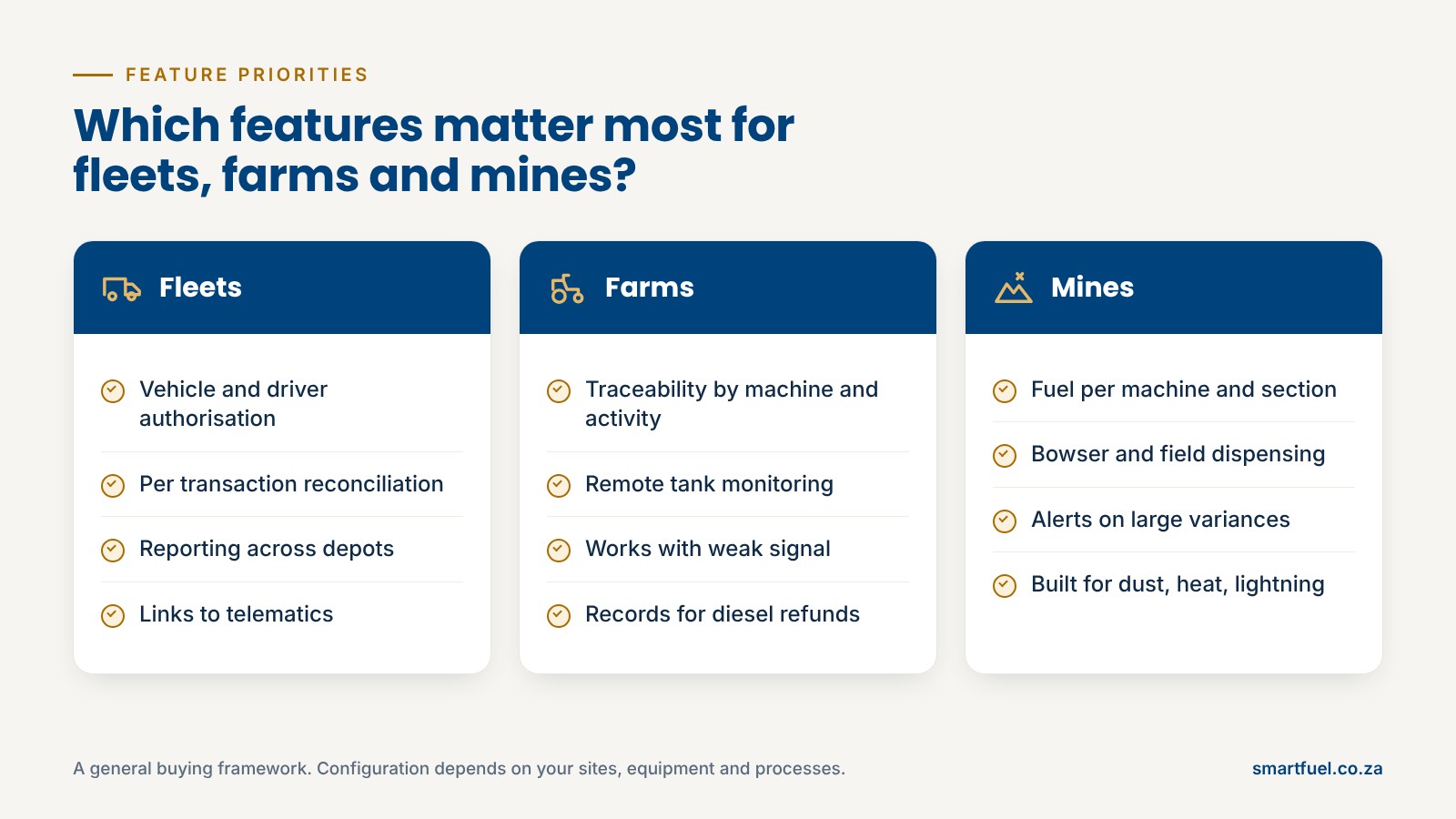
| Operating environment | Highest priority features | Key buying considerations |
|---|---|---|
| Fleets and logistics | Authorisation, reconciliation, multi-site reporting, integration | Vehicle and driver identification, litres per kilometre, links to telematics, reporting across depots |
| Agriculture | Traceability, tank monitoring, site suitability | Fuel linked to machinery and activities, remote tanks with weak signal, records that support diesel refund processes |
| Mining | Traceability, tank monitoring, alerts, site suitability | Fuel per machine and area, bowser and field dispensing, dust, heat and lightning, high-volume reconciliation |
Fleets and transport operators
For fleets assessing fuel management software South Africa providers, the most common weak point is the link between the pump and the vehicle. Prioritise authorisation that ties each fill to a registered vehicle, then compare litres dispensed with kilometres travelled. If you already use a telematics platform, integration can save a lot of manual matching. Our guide on how to choose the right fuel management system provider covers how to compare suppliers on cost and support once you know which features you need.
Farms and agricultural businesses
Farms often run tanks far from the office, with tractors, harvesters and bakkies drawing from the same supply. When farms compare fuel management software South Africa providers, traceability by machine and activity matters most, followed by monitoring that works with limited connectivity. Ask how engine hours are recorded and how records are kept for each piece of machinery.
Diesel records and the SARS Diesel Refund Scheme
Agricultural readers should know that SARS changes in 2026 raise the stakes on good records. According to the official SARS Diesel Refund Scheme page, from 1 April 2026 primary sector claimants operating on land may claim a refund on 100% of eligible diesel used in qualifying farming, forestry and mining activities. SARS also moved diesel refund registration to a dedicated platform on eFiling, implemented on 18 September 2026, and states that existing users must register again because registration is not automatic.
SARS requires purchase documents and logbooks showing eligible and non-eligible use to be kept for five years. Fuel management software can help produce consistent, traceable records, but it does not establish eligibility or guarantee a refund. Confirm your position with SARS or a qualified tax practitioner. SmartFuel’s agricultural offering describes an online diesel logbook intended to simplify rebate submissions.
Mines and mining contractors
Mines tend to dispense large volumes from fixed depots, mobile bowsers and fuel trucks into equipment that operates around the clock. In mining, fuel management software South Africa sites depend on must cope with that scale. Tank monitoring and fast reconciliation help keep big variances from building up, while traceability per machine supports cost control by section. SmartFuel’s mining page describes accounting for every litre dispensed from fuel trucks in the field. Environmental suitability and support response times deserve extra attention in remote, harsh locations. Qualifying mining activities may also fall within the SARS diesel refund rules, which depend on the specific activity.
Fuel management software South Africa checklist: questions to ask a provider
Use these questions with any supplier you evaluate. Ask for written answers, and ask to see the relevant reports from a live site where possible.
- Site and equipment: Will you assess our sites, and does the system work with our existing tanks, pumps and meters?
- Monitoring and authorisation: Which probes and identification methods are included in your proposal?
- Data accuracy: How are probes calibrated, and how are missing or delayed readings handled?
- Reconciliation: Which parts are automatic, and which still need manual capture?
- Multi-site: Can reports separate and compare each of our locations?
- Connectivity and power: What happens during outages or signal loss?
- Integration and exports: Which systems can you connect to, in which formats, and at what cost?
- Training and support: Who trains our staff, and what are the support arrangements in our region?
- Data ownership: Who owns the data, and how do we retrieve it if we leave?
- Measurement: How will we know, after three or six months, whether the system is working?
How to evaluate whether the system is working
Buying fuel management software South Africa teams can trust is only half the job. Before installation, record a baseline. Capture at least a few months of fuel purchased, fuel dispensed, known losses and the time your team spends compiling fuel records. Without a baseline, any claimed improvement is a guess.
After go-live, track the same measures consistently:
- Fuel purchased compared with fuel dispensed, per site.
- Fuel use by vehicle, machine, site or activity, where reliable data is available.
- The size and frequency of unexplained reconciliation differences.
- Unauthorised or failed dispensing attempts.
- Time spent preparing and reconciling fuel records.
- Litres per kilometre, per engine hour or per unit of output.
Compare fairly. Seasonal workloads, route changes and fleet changes all affect fuel use, so compare similar periods and note anything unusual. Results depend on your starting point, the controls you put in place and how consistently they are followed.
Frequently asked questions
What is fuel management software?
Fuel management software records, controls and reports fuel movement from tank delivery to dispensing into a vehicle or machine. It usually works with tank probes, pump controllers and identification tags, and produces reports used for reconciliation and cost control.
What is the difference between fuel management software and a fuel management system?
The software is one part of a fuel management system. The full system also includes hardware at the tank and pump, identification devices, communications equipment and the procedures your staff follow.
What features should a fleet fuel management system have?
A fleet system should at least offer vehicle or driver authorisation, per transaction records, tank monitoring and reconciliation. Multi-depot reporting and integration with telematics are valuable for larger fleets.
Is fuel management software suitable for farms?
Yes, provided the equipment suits remote sites with limited power and signal. Farmers comparing fuel management software South Africa providers should ask about connectivity first. Farms benefit most from traceability by machine and activity, which also helps with diesel record keeping.
Can fuel management software help identify fuel theft?
It can help identify discrepancies and unauthorised dispensing that may indicate theft. A discrepancy is a reason to investigate, though, not proof of theft, and no system eliminates theft without good processes.
Can fuel management software integrate with existing business systems?
Some systems can, but integration varies by provider. Ask which fleet, telematics or accounting systems are supported, whether data can be exported, and whether integrations carry extra costs.
Can agricultural fuel records support SARS diesel refund processes?
Accurate, traceable records can support a diesel refund claim, and SARS requires records to be retained for five years. Software alone does not establish eligibility, so confirm your position with SARS or a tax practitioner.
Choosing the right system for your operation
The best fuel management software South Africa businesses can choose is the one whose controls, records and reports fit its actual tanks, vehicles, machines and sites. Use the nine features as a checklist, put the questions to every provider, and insist on a baseline so you can judge results honestly. If you would like to see how tank monitoring, RFID authorisation and reporting could work at your sites, speak to the team at SmartFuel about a site assessment.