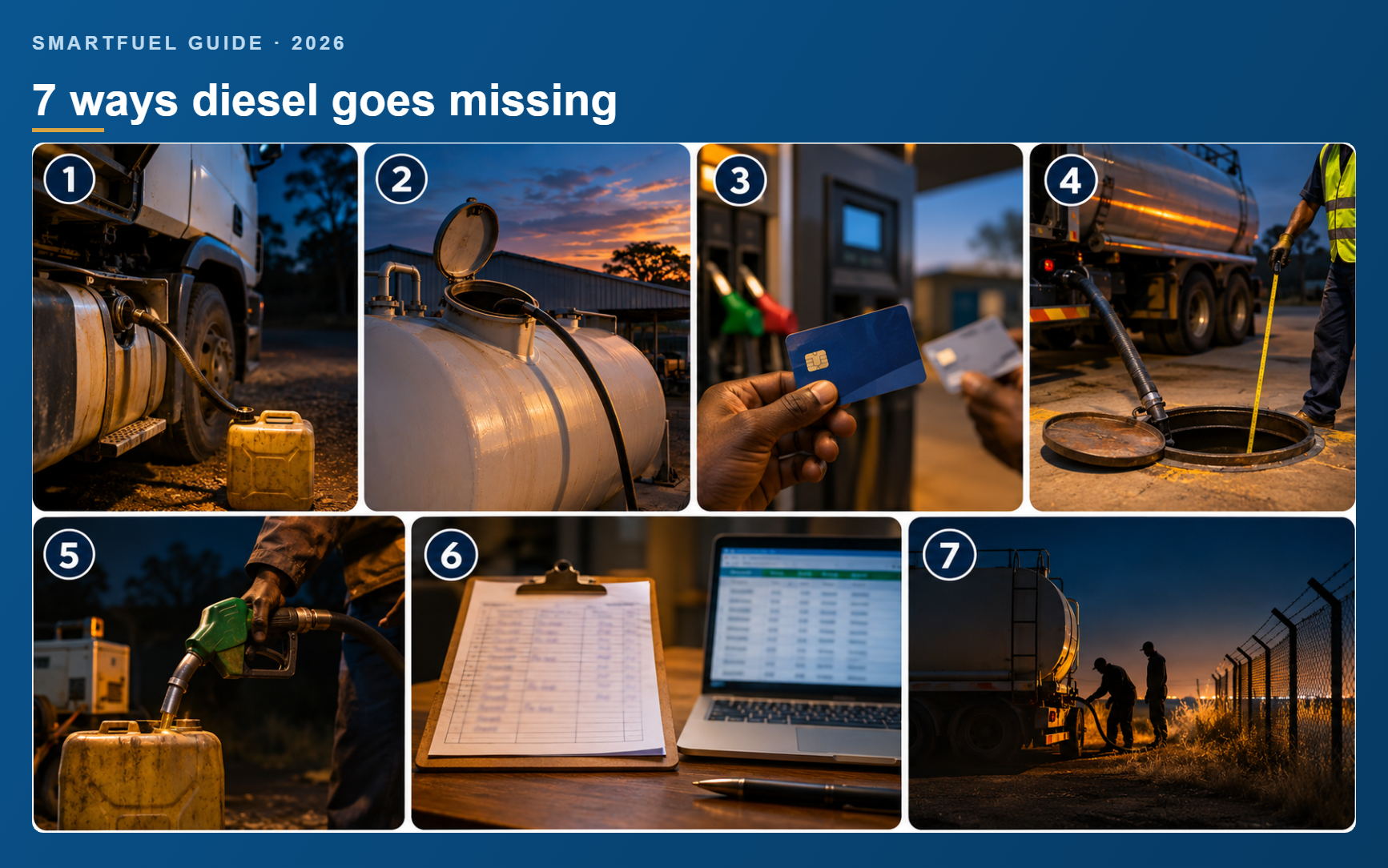
Fuel theft prevention in South Africa starts with knowing the seven ways businesses actually lose diesel: siphoning, tank draining, card fraud, short deliveries, unauthorised dispensing, falsified records and organised theft. This guide shows how each one works and how to stop it, with help from a South African fuel management specialist if you want it.
We reviewed trade, industry and news sources and name each one. South Africa has no single national dataset on diesel theft, so loss figures are estimates and the chart numbers are illustrative. We have not tested any product.
Key takeaways
- Most diesel loss is small and repeated, which makes it hard to trace without records.
- Seven routes cover most losses: siphoning, tank draining, card fraud, short deliveries, unauthorised dispensing, falsified records and organised theft.
- Layer your defences: physical locks, access control, level alerts and regular reconciliation.
- An alert only helps if a named person responds, and reconciliation catches what alerts miss.
- Build evidence from several records before you accuse anyone.
How do businesses lose diesel in South Africa?
Businesses lose diesel through seven routes: siphoning from vehicles, draining storage tanks, fuel card fraud, short deliveries, unauthorised dispensing, falsified records and organised external theft. Most losses are small and repeated, so the fix is layered: lock the physical points, control who can dispense, monitor levels and reconcile every litre.
Chart 1: Seven places diesel leaves your site
Illustrative site layout. Select a numbered point, or tab to it and press Enter.
What are the seven ways diesel is stolen?
IFS, a product seller, notes that many businesses never report small losses. It names overnight parking yards, construction and mining sites, farms and rural depots, truck stops and depots as hotspots. Unsourced percentage estimates circulate, so we do not repeat them. Chart 2 sizes your own routes.
1. Siphoning and roadside sales
Farmer’s Weekly reports TLU SA saying truck drivers often sell diesel to roadside traders without the owners’ knowledge, in quantities of 20 to 40 litres a transaction that are hard to trace. IOL reported city workers in eThekwini caught siphoning diesel from municipal vehicles to sell it.
2. Draining storage tanks
TLU SA says diesel is often drained from storage tanks in crop areas, usually in small amounts with a massive cumulative effect. Centretank says lockable caps on the fill point and inspection chamber are the easiest way to close those access points. Farms can also see SmartFuel’s agricultural fuel management page.
3. Fuel card fraud and collusion
Avis Fleet lists inflated card transactions, cloned cards, side fuelling and multiple pump transactions among six common fraud types. Cartrack cites a case of a suspect said to have colluded with fuel attendants, using government fuel cards to siphon diesel meant for construction machinery.
4. Short deliveries
Less fuel arrives than the docket says. Servopro, an Australian guide, advises matching the docket to the order, dipping before and after delivery and photographing the docket, dips and seals. Gilbarco says real-time wetstock monitoring captures delivery events as they occur.
5. Unauthorised dispensing
Fills after hours, on shared PINs or with no record. Fleetio notes that on-site fuelling brings its own leaks, including handwritten PIN logs. Fuel Marketer News describes pumps that stay off until the operator enters the required information.
6. Falsified or loose records
Infrastructure News reported that an Excel spreadsheet is the most common fuel management system in South Africa. Focus on Transport describes how regular theft can be explained away by averages, because a few thieves hide behind honest drivers.
7. Organised external theft
Agri SA told Farmer’s Weekly that pipeline theft is carried out by highly organised groups using large tankers, and Daily Maverick reported more than 30 pipeline incidents with over two million litres stolen in one 2020 spell. For most sites, the answer is perimeter security and alerts that reach a person at night.
Chart 2: Which routes cost you the most litres?
Placeholder numbers. Replace them with your own estimates from dips, deliveries and dispensing records. No published South African dataset gives route-level splits.
How does fuel theft prevention in South Africa stop each type of diesel theft?
A vendor checklist from HVI groups defences into physical security, real-time monitoring and driver policy. We add reconciliation as a fourth layer, because it catches what the first three miss.
- Locks and barriers. Centretank says lockable caps are one of the first actions, and a steel tank with secure doors suits large stocks. TLU SA suggests seals, specialised valves and tracking.
- Access control. Allow only identified vehicles and operators to dispense, and log every override.
- Level alerts. Banlaw says real-time remote tank level monitoring unlocks immediate tank security, and UK police advice recommends alarms when a level suddenly drops.
- Reconciliation. Banlaw says reconciliation reporting identifies variations between what you buy and what ends up in your tank. Our fuel reconciliation explained page covers the method.
Chart 3 shows how an alert threshold limits what is lost before anyone knows. Chart 4 tests which layers catch which route.
Process matters as much as hardware. A Fuels Industry report on a spill at a TotalEnergies retail site found the delivery procedure was not followed: dips were taken with the wrong dip stick, and a gap between the manual dip and the tank gauge was not flagged or reported. Checking the method and escalating mismatches costs very little. Written rules also help, because Webfleet notes that long routes, overnight stops and remote conditions make fuel harder to monitor without the right systems.
Chart 3: How a night alert limits what is lost
Illustrative. The vertical axis is in litres and starts at 3 000, so the steps are easier to see. Daytime steps are example fills. A real alert also needs someone to respond.
Chart 4: Which layers stop which theft route?
Illustrative. Which layer catches which route is our judgement from the sources, not a measured result. Reconciliation flags a loss after the fact.
How do you tell theft from ordinary fuel loss?
Not every variance is theft, because temperature, tank charts and timing all create gaps. IFS suggests watching for higher-than-expected consumption, more frequent refuelling, differences between similar vehicles or routes and mismatches between dispensed and recorded litres, and investigating patterns because single signs prove nothing. Before disciplinary or police action, build evidence from several records, as Chart 5 shows. SmartFuel’s fuel theft prevention page explains how that evidence trail works.
Heat is one harmless cause of a gap. Mail & Guardian reported that heat expansion changes the volume a tanker offloads compared with what was loaded, so note the temperature and delivery time when you dip. Repeat gaps on the same route, vehicle or shift point to a cause worth chasing.
Chart 5: How strong is your evidence file?
A practical rule of thumb, not a legal standard. Get advice before disciplinary or criminal action.
Fuel theft prevention controls compared
Descriptions come from the sources above, so confirm each point with the supplier. Our fuel management system provider guide covers how providers differ.
| Control | Best against | Limits |
|---|---|---|
| Lockable caps, anti-siphon devices | Siphoning, tank draining | Physical only, and no record of what was taken |
| Secure enclosure or cage | Drain-off at bulk tanks | Slows access but does not prove a loss |
| Authorised dispensing (tag or PIN) | Unauthorised and unrecorded fills | Needs meter proving and prompt exception review |
| Fuel card limits | Card fraud, over-fills | Covers card purchases, not your own tank |
| Tank level alerts | Night draining, delivery shortfalls | Only helps if someone responds |
| Reconciliation | Small repeated losses, hidden gaps | Only as good as the dips, meters and records |
| Integrated system (SmartFuel, to confirm per site) | Real-time wireless level monitoring, authorised dispensing and chain of custody tracking against routes 2 to 6 | Confirm the hardware, alert routing and report formats with SmartFuel |
Checklist: a fuel theft prevention routine for South African sites
- Lock fill points, inspection chambers and pump controls.
- Give every vehicle and operator an identifier, and end shared PINs.
- Set approved dispensing hours and review fills outside them.
- Dip and photograph before and after every delivery, and keep the docket.
- Monitor tank levels and send night alerts to a named person.
- Reconcile receipts, issues and closing stock every week.
- Compare litres per hour or kilometre across similar vehicles each month.
- Record every variance with a cause, evidence and a reviewer.
When is a fuel management system not the right move?
- You run one small tank with one trusted operator, and a weekly dip already balances inside your tolerance.
- Your losses happen in vehicle tanks off site. Tracking and driver policy matter more, and SmartFuel’s logistics fuel management page shows where the chain differs.
- Nobody will respond to night alerts. An alert that nobody reads protects nothing.
- The basics are not fixed. Unlocked tanks, shared PINs and unproven meters come first.
Fuel theft prevention in South Africa: frequently asked questions
How do businesses lose diesel in South Africa?
Mostly through small, repeated losses: siphoning, drivers selling fuel to roadside traders, tanks drained after hours, card fraud, short deliveries, unrecorded dispensing and falsified records. Organised groups also target pipelines and remote sites. Because no national dataset exists, each business needs its own reconciliation to size the loss.
How much diesel is stolen in South Africa?
Nobody knows exactly. IFS says there is no single national dataset because many businesses never report small losses, and the percentage estimates in circulation are unsourced. TLU SA says the illegal diesel trade could reach millions, if not billions, of rand a year. Measure your own loss by reconciling every litre.
What is the best way to stop diesel siphoning?
Use layers. Lockable caps and anti-siphon devices close the physical access, level alerts show sudden drops, and litres-per-kilometre checks expose siphoned vehicles. Cartrack and Centretank both recommend physical protection alongside monitoring. No single device stops every method.
How do you detect diesel theft at night?
Fit tank level monitoring with an alert for sudden drops outside approved hours, and send it to a named person who must respond. UK police guidance describes remote gauges that raise an alarm when a tank level suddenly drops. Without a responder, an alert only records the loss.
How do you check a fuel delivery is not short?
Confirm the delivery docket matches your order, dip the tank before and after delivery, and photograph the docket, dips and truck seals. If you have tank gauging, capture those readings too. These steps give independent evidence when you raise a shortage with the supplier.
Is a missing diesel litre always theft?
No. Temperature, tank charts, meter error and timing gaps all create variances, and a typing slip can look like a loss. Investigate patterns across several records, such as tank levels, dispensing logs and delivery dockets, before accusing anyone or involving the police.
Stop losing diesel you cannot see
For a closer look at how SmartFuel approaches this, see our fuel theft prevention service. SmartFuel is a South African fuel management company with 26 years of experience, trusted at 600+ sites and based in Johannesburg.
Ready to find where your diesel goes? Contact the SmartFuel team or call +27 11 615 3437.
Sources
- Farmer’s Weekly: Diesel worth millions stolen every year
- Farmer’s Weekly: Transnet pipeline theft
- Daily Maverick: Diesel theft and Agri SA
- IFS: Diesel theft, the silent drain
- IOL: eThekwini diesel theft
- Engineering News: Fleet fuel fraud
- Cartrack: Fuel siphoning and fuel security
- Centretank: Diesel fuel security
- Banlaw: Fuel security hacks
- Police Scotland: Fuel theft advice (PDF)
- Servopro: Fuel delivery discrepancy
- Gilbarco: Fuel delivery monitoring
- HVI: Diesel theft prevention checklist
- Fleetio: On-site fleet fuelling
- Fuel Marketer News: Pump access
- Infrastructure News: When fuel goes missing
- Focus on Transport: An oily layer of subterfuge
- Fuels Industry: Loss of containment at a retail site (PDF)
- Mail & Guardian: Heat expansion and tanker volumes
- Webfleet: Fuel theft prevention in South Africa