Fuel management for mines means tracking every litre from the supplier’s tanker to the bulk tank, the bowser and the haul truck that burns it. This guide shows where diesel moves on a South African mine, where it goes missing and how to reconcile three numbers: litres delivered, litres issued and litres burned.
It comes from SmartFuel, a South African fuel management company, so treat vendor claims, ours included, with care. We reviewed South African studies and trade sources and name each one. Chart numbers are illustrative, and we have not tested any product.
Key takeaways
- Diesel is a very large share of open-cast operating cost, so small percentage gaps are large rand amounts.
- Track four hops: supplier delivery, bulk tank, bowser or fuel truck, and the machine.
- Reconcile three numbers on a schedule: delivered, issued and burned.
- Compare haul trucks by litres per engine hour, not litres per fill.
- The same records support a compliant SARS diesel rebate logbook.
How do you track diesel across haul trucks and bulk tanks?
Track diesel at every hop: meter the supplier delivery, level-monitor the bulk tank, meter each bowser dispense by vehicle and record each haul truck’s litres per engine hour. Then reconcile three numbers on a schedule: litres delivered, litres issued and litres burned. A gap at any stage shows where the loss sits.
Why does mine diesel need tighter control?
A South African Journal of Industrial Engineering paper on open-cast gold mining says diesel accounts for around 46% of operational costs there. It powers dump trucks, excavators, loaders, graders and water trucks. A Deloitte sample cost breakdown for a southern African open-cast mine puts fuels and lubricants near 40%. Published shares differ by mine, so use your own.
A 2022 CSIR briefing to Parliament put mining’s fuel use at 2.2 billion litres a year.
The rebate adds a second reason. The same journal authors note that compliant logbooks are a key requirement for the diesel rebate, that the industry struggles to verify them, and that non-compliance has stopped eligible mines from benefiting (paper). Bizcommunity reports the refundable portion for qualifying primary producers, including mining on land, rose to 100% of the fuel levy from 80%, and that claimants need data to substantiate usage. Check the effective date and your eligibility on the SARS page.
A Wits study of the Bathopele platinum mine reported that adding internet of things technology to its fuel management brought consumption tracking, inventory management, theft prevention, leak detection and easier access to data for rebate applications. Our mining fuel management page covers the SmartFuel approach.
Where does diesel move on a mine, and where does it go missing?
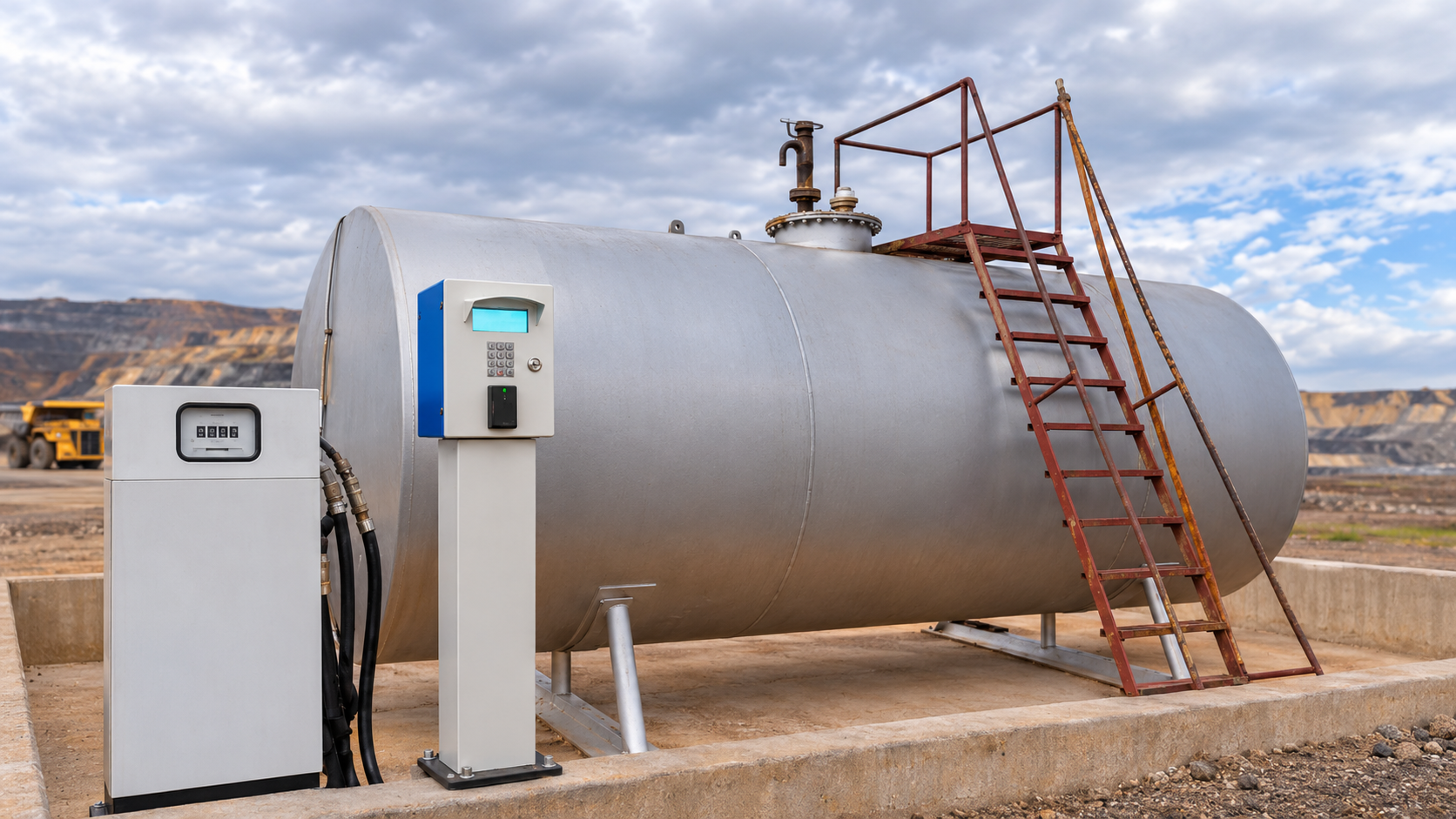
Diesel passes through four hops, and each needs a reading. HVI, a vendor, describes a mine running several fuel bunkers across the pit, the run-of-mine pad and underground bays, with a fuel truck on a circuit feeding haul trucks. Gilbarco splits mining control into delivery, tank, fixed site, refuelling and bowser control.
- Delivery. Fuel expands and contracts with temperature in the delivery truck and the tank, which Gilbarco lists among loss sources, so record temperature and compare the docket with the dip.
- Bulk tank. Minetec describes level sensors on all bulk tanks and mobile bowsers at Menar’s mines, plus water sensors to monitor fuel quality.
- Bowser or fuel truck. Every dispense should be metered and tied to a vehicle, not written on a sheet at the end of the round.
- Machine. Compare what a machine took with what it burned over its engine hours.
Chart 1 maps the network. Our fuel theft prevention page covers where thieves target it.
Chart 1: The fuel network on a mine
Illustrative layout. Amber dots mark the links where a meter or reading should exist. Select a numbered point, or tab to it and press Enter.
How do you reconcile bulk tanks, bowsers and haul trucks?
HVI’s mining guide says a reliable reconciliation starts with the tank balance, then matches dispensing records to individual assets. Its worked example: a mine receives 40,000 litres, the bowser records 31,000 dispensed and the tank gauge shows 7,400 left, so 1,600 litres are unexplained, but not necessarily stolen (HVI). Its other example has a 30-truck fleet taking delivery of 180,000 litres, issuing 176,400 and burning 171,200 (HVI). Each gap sits at a different stage: tank to bowser, and bowser to machine.
Gaps are not always theft. Temperature, meter drift, missing transactions and measurement basis all play a part, and Gilbarco separates physical loss from adjusted losses caused by poor data. Thresholds vary: Gilbarco’s platinum mine case study cites an industry threshold of 0.5% for daily wet stock variances, while FleetRabbit says many operations flag about 5% between dispensed and consumed fuel. Both are vendors, and no South African standard fixes the figure. Our fuel reconciliation explained page covers the method, and Chart 2 shows the trade-off.
Chart 2: Where should you set your variance limit?
Fourteen made-up daily variances. Gilbarco quotes a 0.5% daily threshold in one case study and FleetRabbit says many sites flag about 5%. Both are vendors, so prove your meters, then set your own.
How do you tell theft from heavy haul truck burn?
Normalise before you compare. HVI says litres per hour only becomes actionable once you add payload, cycle time and haul distance, because a truck on a long uphill haul burns more. Schneider Electric says the largest haul trucks use up to about 350 litres an hour, and HVI puts ultra-class trucks at 300 to 500 litres an hour (HVI).
Compare each truck with its twins on the same haul. A truck burning more than its sibling may have injector wear or a clogged filter, or fuel may be leaving by another route, and the data tells you where to look first. Chart 3 shows how raw fills can hide one truck.
Chart 3: Six haul trucks, two ways to read them
Seven shifts of made-up data. One truck burns about 20% more per hour than its twins, but varying shift lengths hide it in the raw litres.
Refuelling habits matter too, because each fill is a record. Chart 4 compares two patterns.
Chart 4: How full is the tank at refuelling?
Made-up distributions. Australian Mining Review describes an AdaptIQ report comparing how much of the tank each dispense fills for two haul truck fleets. Your own data will differ.
How do you control bowsers and fuel trucks?
The fuel truck is the weakest link on many sites because it moves, so it needs its own meter, its own level reading and its own reconciliation. HVI says a mine relying on a clipboard at the bowser and a month-end spreadsheet is relying on memory and honesty. Log every litre the truck dispenses on its round against the receiving machine, and reconcile the truck’s own tank at the end of the round. Chart 5 shows how one unlogged fill breaks the balance.
Chart 5: One bowser round, stop by stop
Illustrative: the bowser starts with 10 000 L and six logged fills. The slider adds a fill nobody logged, so the book balance and the dip drift apart.
Mine fuel control points compared
Confirm each point with the supplier. Our fuel management system provider guide covers how providers differ.
| Control point | What to capture | How often | Common gap |
|---|---|---|---|
| Supplier delivery | Docket volume, dips before and after, temperature | Each delivery | Short or unrecorded loads |
| Bulk tank or bunker | Level, water, and every transfer out | Continuous, with alerts | Unmonitored tank or stale chart |
| Bowser or fuel truck | Litres per dispense, by vehicle | Every dispense and every round | Sheets filled in later |
| Fixed dispenser | Authorised vehicle, litres, time | Every fill | Shared access, unproven meter |
| Haul truck | Litres per engine hour, with payload and cycle | Per shift | Comparing raw litres |
| Other vehicles and plant | Hours or distance against litres | Weekly | Fills outside the system |
| Rebate logbook | Reconciled litres by eligible use | Monthly | Rebuilt from memory |
| SmartFuel mining solution (to confirm per site) | Real-time wireless level monitoring, theft prevention and chain of custody tracking | Per site survey | Confirm hardware, alert routing and reports |
When is a fuel management system not the right move for a mine?
- The basics are not fixed. Unproven meters, wrong tank charts and open fill points come first.
- Nobody owns the fuel number. Without a named person reviewing variances, flags go nowhere.
- You track haul trucks only. Bowsers, light vehicles and plant also draw fuel, and a gap there looks like truck burn.
- The site is tiny. HVI argues one bunker and one fuel truck is where a clipboard breaks down, but a very small operation should compare quotes with its own losses first.
Checklist: tracking diesel from tanker to haul truck
- Map every fuel point: bunkers, bowsers, fixed dispensers and tanker routes.
- Prove and tag every meter, and record the proving date.
- Fit level monitoring to every bulk tank and mobile bowser.
- Identify every machine automatically at the point of fuelling.
- Capture each delivery with dips, temperature and docket volume.
- Reconcile delivered, issued and burned on a fixed schedule.
- Compare haul trucks by litres per engine hour against their twins.
- Keep records in a form that supports your SARS rebate logbook.
Fuel management for mines: frequently asked questions
How do you track diesel on a mine?
Meter and record every hop: the supplier delivery, the bulk tank level, each bowser or fixed dispense by vehicle, and each machine’s litres per engine hour. Then reconcile litres delivered, issued and burned on a schedule. Sensors and vehicle identification replace written slips, and a named person reviews the variances.
How do you reconcile bulk tanks and haul truck fuel?
Start with the tank balance: opening stock plus deliveries minus issues should equal closing stock. Then match issues to each machine and compare them with burn over engine hours. HVI’s example finds 1,600 litres unexplained on a 40,000 litre receipt, which is a prompt to investigate, not proof of theft.
What variance is acceptable on a mine?
No South African standard fixes it. Gilbarco cites a 0.5% daily threshold in a mine case study, while FleetRabbit says many sites investigate about 5% between dispensed and consumed fuel. Both are vendors. Prove your meters first, watch your normal variance for a few weeks, then set limits that catch real losses without constant false alarms.
How much diesel does a haul truck use?
It depends on the truck, payload, haul route and cycle time. Schneider Electric says the largest haul trucks use up to about 350 litres an hour, and HVI puts ultra-class trucks at 300 to 500 litres an hour. Treat both as vendor figures and use your own engine-hour data for each model.
Does fuel tracking help with SARS diesel rebate claims?
Yes, because compliant logbooks need accurate records of litres by eligible use. A South African Journal of Industrial Engineering paper says the industry struggles with logbook verification, and a Wits study reports easier rebate applications after adding fuel data tracking. Confirm your eligibility and the current refund rate with SARS or your tax adviser.
Can a small mine or quarry justify fuel management?
There is no fixed size. HVI argues that a site with one bunker and one fuel truck is already where clipboards break down, but that is a vendor view. Compare quotes with your own diesel volume, price and likely losses, and start with the cheapest controls first: metered dispensing and tank level monitoring.
Know where every litre on your mine goes
For how SmartFuel approaches mining sites, see our mining fuel management page. SmartFuel is a South African fuel management company with 26 years of experience, trusted at 600+ sites and based in Johannesburg.
Want a survey of your tanks, bowsers and haul trucks? Contact the SmartFuel team or call +27 11 615 3437.
Sources
- SAJIE: Holistic diesel management system, open-cast gold mining
- SAJIE: Diesel rebate logbooks in mining (PDF)
- University of the Witwatersrand: Fuel management at Bathopele mine
- CSIR briefing to Parliament, March 2022 (PDF)
- Deloitte: CNG and LNG in mining (PDF)
- Bizcommunity: Offsetting the rising diesel price
- SARS: Diesel refund increase from 80% to 100%
- Mining Weekly: Demand high for automated fuel system
- Gilbarco: Open-cast platinum mine case study
- Gilbarco: Detecting and reducing fuel losses in mining
- Gilbarco: Industrial and mining fuel solutions
- HVI: Mining fuel reconciliation and loss control
- HVI: Mining fuel bunker tracking and consumption
- HVI: Mining fuel bunker and fuel truck management
- HVI: Fuel tracking for off-highway fleets
- Schneider Electric: Fuel management for mining
- FleetRabbit: Mining fuel reconciliation software
- Australian Mining Review: Fluid dynamics